
Cannabis Control Act arrests increased in Illinois in 2024, marking the first year-over-year increase since cannabis possession was decriminalized in 2016, according to newly released state data. A separate analysis released by the Marijuana Policy Project (MPP) found Illinois had the highest cannabis arrest rate per capita among states that have legalized adult-use cannabis. Together, the findings suggest criminal enforcement remains a significant component of Illinois cannabis policy six years after legalization.
Drawing largely from data published in the Illinois Annual Cannabis Report for 2025 and the Illinois Adult Use Cannabis Health Advisory Committee’s 2025 Report, this analysis examines the continued use of criminal enforcement following cannabis decriminalization in 2016 and the enactment of the Cannabis Regulation and Tax Act (CRTA) in 2020.
- Cannabis Control Act Arrests Increased in 2024
- Violations of the Cannabis Control Act
- Odor-Proof Cannabis Packaging
- Changes in Expungement Tracking
- Illinois Leads Legalization States in Cannabis Arrests
Cannabis Control Act Arrests Increased in 2024
Illinois released two reports in 2025 that include data on the continued criminalization of cannabis in Illinois. The Illinois Annual Cannabis Report includes statewide arrest data that, in some cases, reflects only Illinois State Police activity. The Adult Use Cannabis Health Advisory Committee’s 2025 Report provides additional data on arrests by local law enforcement.
Cannabis Control Act arrests in Illinois declined sharply between 2016 and 2021, falling from more than 33,000 arrests in 2016 to just over 5,000 by 2021. The steepest reductions occurred when Illinois decriminalized the possession of small amounts of cannabis in 2016.
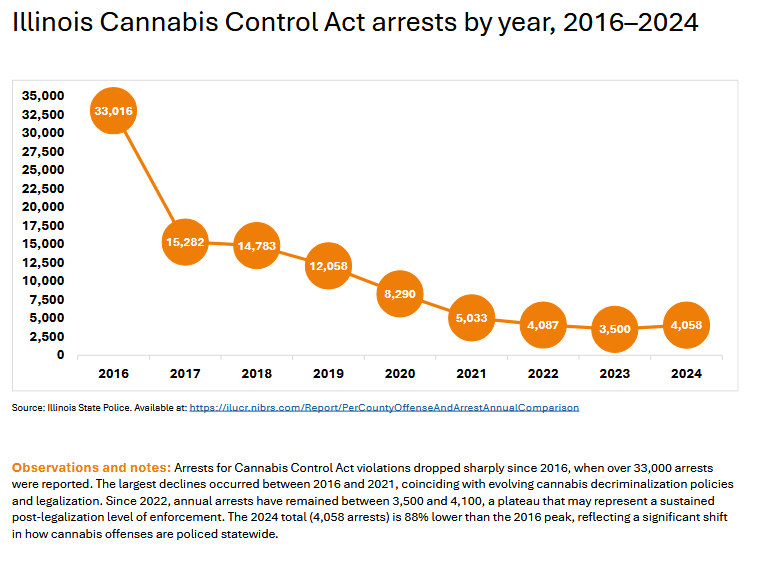
Following the passage of the CRTA, arrest totals did not continue to fall at the same pace. Instead, arrests stabilized beginning in 2022, fluctuating between roughly 3,500 and 4,100 per year.
In 2024, Cannabis Control Act arrests increased to 4,058, marking the first year-over-year increase since decriminalization in 2016. Overall, Cannabis Control Act arrests in 2024 remained approximately 88 percent lower than their 2016 peak.
“The ISP Investigative Zones seized approximately 16,738,186 grams (approximately 36,901 pounds or 18.5 tons) of illicit cannabis, including 14 cannabis plants, with an estimated street value of $251,072,790 and recovered 204 firearms in FY25…14 illicit cannabis plants were seized, which at harvest, can yield up to one pound of cannabis “buds” per plant.”
Excerpt from ISP’s section of the Illinois 2025 Annual Cannabis Report
Enforcement Patterns
The criminal justice section of the 2025 Annual Cannabis Report from the Adult Use Cannabis Health Advisory Committee includes data on Cannabis Control Act (CCA) enforcement and incarceration outcomes.
According to the report, 57.5% of those incarcerated for CCA were Black or African American, compared with 28.7% who were White.
Enforcement in Chicago
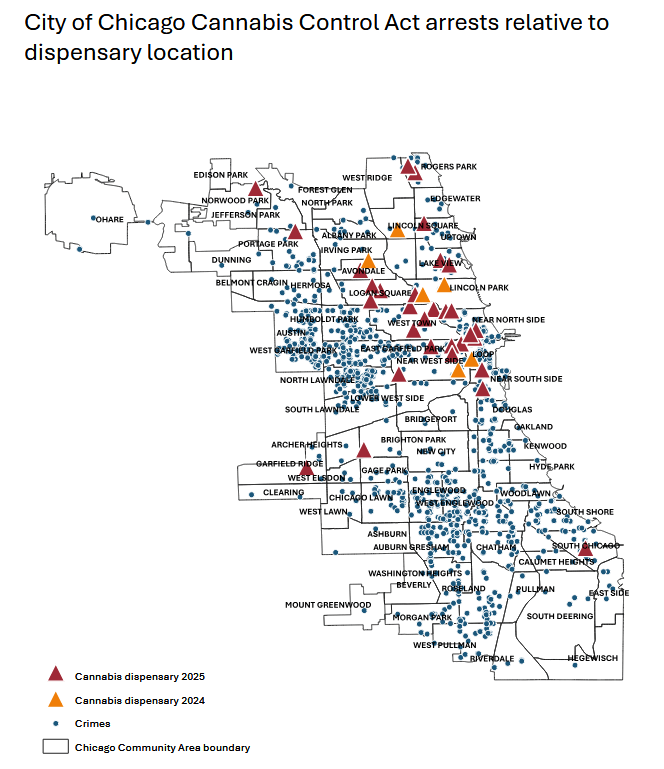
Data included in the Adult Use Cannabis Health Advisory Committee’s 2025 report suggests cannabis enforcement remains geographically concentrated in Chicago, particularly on the city’s South and West Sides. According to the report, communities with the highest concentrations of cannabis arrests often had little to no legal market presence, highlighting continued geographic and racial disparities in post-legalization enforcement.
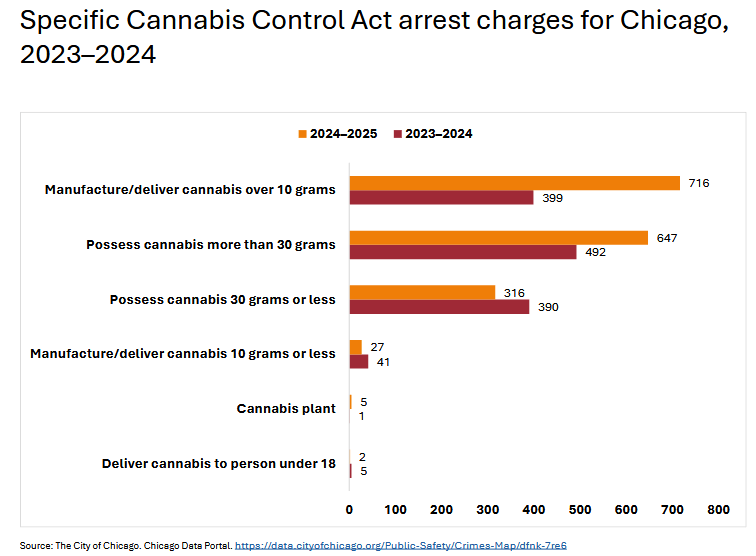
In 2024, arrest patterns shifted notably for higher-quantity cannabis offenses. Arrests for possession of more than 30 grams increased from 492 to 647, while arrests for manufacture or delivery involving more than 10 grams rose from 399 to 716. At the same time, arrests for possession of 30 grams or less and manufacture or delivery of 10 grams or less continued to decline.
Cannabis arrests in Chicago are increasingly concentrated in cases involving larger quantities and alleged intent to distribute. While low-level possession arrests continue to fall, cannabis-related criminal enforcement remains active in the city.
Violations of the Cannabis Control Act
The Illinois Cannabis Control Act (CCA) became law in 1978 and has since served as the state’s primary criminal statute governing cannabis possession, cultivation, manufacturing, and distribution. When Illinois passed the Cannabis Regulation and Tax Act (CRTA) in 2019, the state did not repeal the CCA. Instead, the CRTA legalized certain cannabis-related activities while leaving the CCA largely in place to govern conduct that remains prohibited under Illinois law.
In the Illinois Annual Cannabis Report, the Illinois State Police report that enforcement of Illinois cannabis laws has been complicated by the rising popularity of cannabis products that qualify as “hemp” under the definition of the 2018 Farm Bill, a piece of federal legislation. The agency notes that products such as THC-infused beverages and high-THCa hemp flower can resemble cannabis sold through Illinois dispensaries, creating challenges for law enforcement and prosecutors.
These products have appeared in well-known stores like Target, Binny’s, as well as breweries, restaurants, movie theaters, and other venues. Chicago’s United Center and Navy Pier recently announced that it will sell THC drinks under this framework.
Illinois State Police note in the Annual Cannabis Report that they’ve observed a growing market for what some call “high-THCa hemp flower”, which is indistinguishable from cannabis flower sold in state-licensed dispensaries from a consumer perspective. The report states that some State’s Attorneys have been reluctant to prosecute cases involving these products due to their legal status.
This dynamic may change regardless of whether Congress takes further action on hemp. At the time of writing, the Illinois General Assembly has passed Senate Bill 3222, and is currently awaiting consideration by Governor J.B. Pritzker.
During House and Senate floor debate, lawmakers stated that the legislation is intended to align Illinois law with the federal hemp definition currently scheduled to take effect in November 2026. During House debate, sponsor Rep. Will Guzzardi said products affected by the change would be enforced “through the same mechanisms through which the illegal sale of THC is enforced today.”
If signed into law, the measure could resolve some of the enforcement challenges Illinois State Police say have arisen from the legal status of certain hemp-derived cannabis products.
Cannabis-related enforcement in Illinois also extends beyond possession and distribution offenses. In the Illinois Annual Cannabis Report, Illinois State Police note that cannabis enforcement includes impaired driving investigations. Reporting by ABC7’s I-Team has raised questions about the interpretation and reliability of certain evidence used in cannabis DUI prosecutions in Illinois.
Destruction of Cannabis
The Illinois Annual Cannabis Report also details activity by the Scene and Evidence Services Command. During FY25, approximately 10,720 pounds of illicit cannabis were transported to Veolia Environmental Services in Sauget, Illinois, for destruction.
According to the report, no Cannabis Control Office funds were used for this effort. However, the use of CCO funding is being explored as an option for future large-scale cannabis destructions.
Odor-Proof Cannabis Packaging
According to the Illinois Annual Cannabis Report, Illinois State Police maintain that retaining the authority to consider cannabis odor as probable cause is critical to identifying criminal activity and assessing impairment.
In the report, the agency detailed that it continues to monitor shifting judicial interpretations and proposed legislative changes that could limit its ability to use odor detection and canine teams, which ISP describes as important tools for drug interdiction and impaired driving investigations.
The Illinois Supreme Court has ruled that the odor of burnt cannabis, standing alone, does not provide probable cause to search a vehicle. The Illinois Supreme Court later ruled that the smell of raw cannabis alone provides police officers with probable cause to conduct warrantless vehicle searches
“Following decriminalization on January 1, 2020, ISP temporarily paused imprinting new canines with the odor of cannabis to evaluate how evolving legislation and court rulings would affect their deployment. This proactive approach prevented the need to replace large numbers of canines at once and preserved flexibility should future rulings favor or restrict cannabis-imprinted canines. Today, ISP supports a canine section of nearly 70 canines—some imprinted with cannabis and some not—ensuring the Department remains adaptable while closely monitoring the legal landscape.”
Excerpt from ISP’s section of the Illinois 2025 Annual Cannabis Report
Click to see articles/interviews that I’ve published on this subject
- Criminal Law Committee in the Illinois Senate Votes to Advance Bill to Ban Vehicle Searches Based on Smell of Cannabis
- Illinois Police and Cannabis Operators Oppose the Cannabis Omnibus
- Episode 172 – I testified against police
- Illinois Supreme Court Upholds Odor-Proof Cannabis Container Law
- Podcast episode with lawyers where we recap Supreme Court rulings on cannabis container
- Odor Proof scene from Mini Doc
- 12:38~14:45
- Episode 213 – Odor Proof Updates + Metrc’s impact on Illinois Medical Cannabis Patients
- Episode 199 – Cannabis Odor Bill Moves Forward but a “Compromise” Could Weaken It
- The proposal that I discussed in this ultimately did not come to fruition
- Cannabis Odor Search Ban Advances in Illinois, but a “Compromise” Could Undermine Its Intent
- The proposal that I discussed in this ultimately did not come to fruition
- Episode 190 – Help End Cannabis-Odor-Based Vehicle Searches in Illinois
- Episode 184 – Breaking: Illinois Senate Advances SB42 to Curb Vehicle Searches Based on Cannabis Odor
- Illinois Senate Advances Bill to Curb Cannabis-Based Traffic Stops, House Consideration Up Next
- After Objections, CPD Agrees Officers Will Not Search Vehicles Based on Smell of Raw Cannabis: Reform Groups
Changes in Expungement Tracking
While cannabis expungements may still be occurring throughout Illinois, state officials report that they can no longer reliably track how many cannabis-related records are being cleared each year.
According to the Illinois Annual Cannabis Report, counties stopped submitting court orders that specifically identify minor cannabis offenses beginning in fiscal year 2024. Instead, those cases are now grouped with non-cannabis expungements in broader court orders.
As a result, the Illinois State Police report that they can no longer comprehensively record or report the number of minor cannabis records being expunged statewide. Under the current reporting structure, cannabis-specific expungement figures included in future annual reports will likely remain unchanged unless counties resume submitting cannabis-specific court orders.
In short, while expungements may still be occurring, the state can no longer reliably report how many cannabis-related records are actually being cleared.
Expungement Eligibility Could Expand
The definition of a “minor cannabis offense” may also be poised for change.
Senate Bill 3222, which recently passed the Illinois General Assembly and is awaiting consideration by Governor J.B. Pritzker, would increase the threshold for a minor cannabis offense from 30 grams to 60 grams. During floor debate, supporters said the change could make more Illinoisans eligible for automatic expungement.
If the measure becomes law, it could expand the universe of potentially eligible records even as state officials report they can no longer reliably track how many cannabis-related records are being expunged each year.
The Illinois Annual Cannabis Report also states that no new omnibus expungement orders were received in 2025 through either the Governor’s Pardon process or the State’s Attorney vacate process. According to Illinois State Police, previously submitted omnibus orders from 64 counties have already been fully processed.
Expungement efforts are intended to address the legacy of cannabis prohibition. However, cannabis-related arrests continue to occur in Illinois, drawing attention from national cannabis policy organizations.
Illinois Leads Legalization States in Cannabis Arrests
In April 2026, the Marijuana Policy Project (MPP) released a report examining cannabis arrests across the United States using FBI Crime Explorer data and state-level arrest data compiled by the ACLU.
According to the report, Illinois recorded the highest cannabis arrest rate per capita of any state that has legalized adult-use cannabis. MPP reported that Illinois law enforcement made 54.16 cannabis arrests per 100,000 residents, a rate higher than every other legalization state.
The organization also found that Illinois was the only legalization state where cannabis possession arrests increased following legalization, rising 3.4 percent. On average, approximately 15 Illinois residents are arrested for cannabis-related offenses each day.
The report by MPP further found that Illinois recorded a higher cannabis arrest rate per capita than three states that continue to prohibit adult-use cannabis: Hawaii, Florida, and New Hampshire.
MPP pointed to provisions of Illinois law that may contribute to the state’s arrest totals. Among them is the Illinois requirement that cannabis in a motor vehicle be stored in a “odor-proof cannabis container” that is inaccessible to all occupants.
The organization also noted that Illinois is one of four legalization states that continues to prohibit home cultivation for most adults.
This article expands on themes discussed in a previous article and incorporates portions of analysis that I originally published in the Illinois State Bar Association’s Cannabis Law Section newsletter in May 2026.
Comment below with your thoughts and consider supporting my work!
You can support The Cole Memo with a one-time, monthly, or yearly contribution.
Support The Cole Memo by making a one-time contribution
Support The Cole Memo with monthly contributions
Support The Cole Memo with yearly contributions
Choose an amount
Or enter a custom amount
Your contribution is appreciated. Your contribution helps us afford equipment to capture our content and hosting fees to distribute our content.
Your contribution is appreciated. Your contribution helps us afford equipment to capture our content and hosting fees to distribute our content.
Your contribution is appreciated. Your contribution helps us afford equipment to capture our content and hosting fees to distribute our content.

Illinois Cannabis Updates, Hemp Restrictions & the Future of Legalization | E329 – The Cole Memo
- Illinois Cannabis Updates, Hemp Restrictions & the Future of Legalization | E329
- Illinois Cannabis Policy, Hemp Restrictions & Home Grow with Brad Spirrison | E328
- Rep. La Shawn Ford on What's Next for Illinois Cannabis Legalization | E327
- Illinois Cannabis Sales Rebound, DEA Rescheduling Update & Governor's Forum | E326
- Massive Outdoor Home Grow, Patient Portal, & Cannabis Event This Week | E325


Leave a Reply