
This article was edited for clarity surrounding the discussion on legal transportation of cannabis in Illinois (paragraph 31). This article was also edited to add a photo of Tiffany Chappel Ingram and I. Edits were made on 12/10/23 at 12:40AM.
When I saw that the Cannabis Business Association of Illinois (CBAI) would be hosting a “fireside chat” with the Cannabis Regulation Oversight Officer (CROO), I was captivated. Given my passion for cannabis policy, events like this always grab my attention.
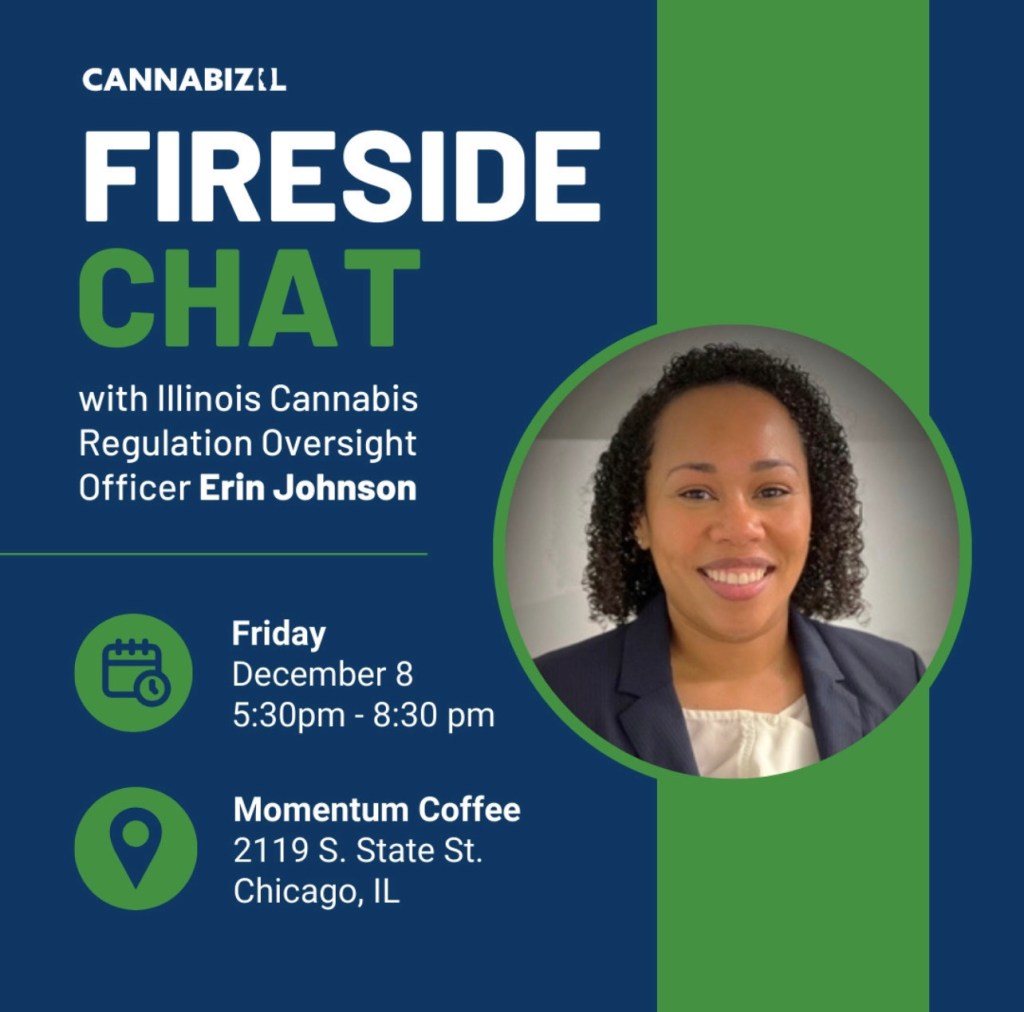
December 8th was a beautiful night in Chicago. As I made my way towards Momentum Coffee, I was pleasantly surprised by the unseasonably warm temperatures. Despite the sometimes violent wind, the comfortable warmth in the air made it an ideal evening to enjoy a few joints outdoors, a stark contrast to the typical frigid winter weather we usually experience this time of year. I began to wonder, will the chat actually be fireside?
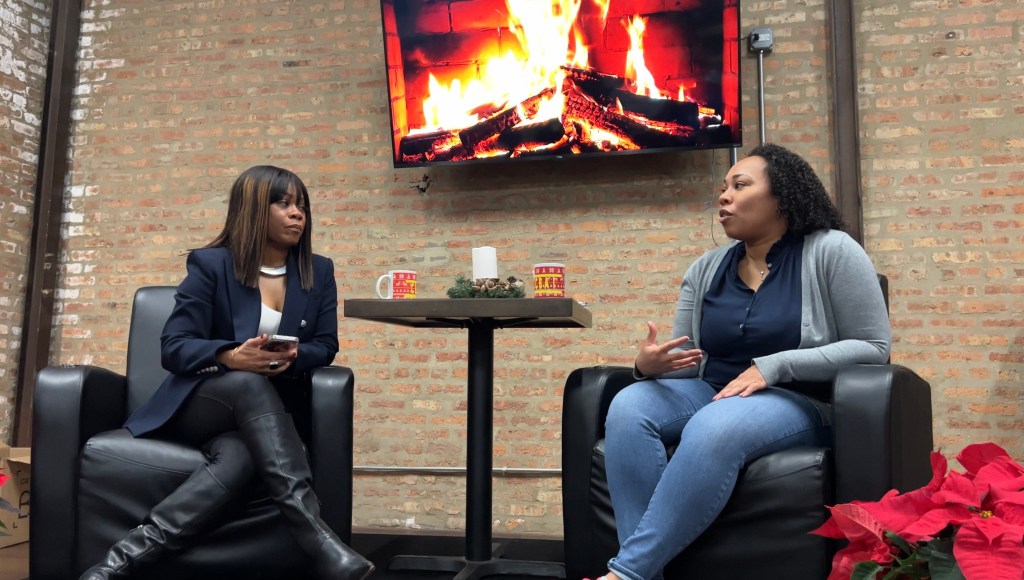
To my delight, it turned out they had a (virtual) fire crackling in the background, completing the cozy fireside chat ambiance.
Momentum Coffee seems to be an awesome host for cannabis-related events, based on what I saw. When I arrived, I noticed that there were snacks and refreshments. It took me longer than I’d like to admit to realize that some of the refreshments were cannabis-infused. I signed in, exchanged greetings with a few attendees, gave friendly waves to familiar faces in the distance, and then settled into my seat. As I settled in, the newly appointed Executive Director for CBAI, Tiffany Chappel Ingram, approached me to introduce themselves.
They were extremely kind to me. They asked me why I decided to show up to the event. I explained what you all (might) already know: I have a deep passion for cannabis-policy and I consume a lot of cannabis. So much so, that I’m willing to travel long distances just to participate in conversations like the one they had organized. I also invited her formally onto the show and gave her my card!
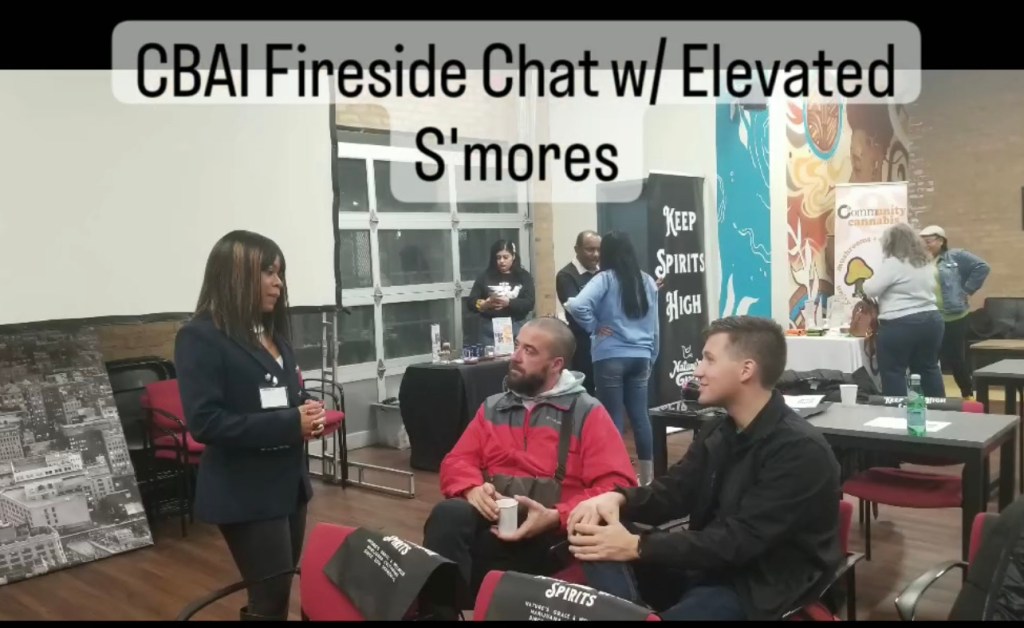
Tiffany was able to confirm my earlier observations: Momentum Coffee is indeed a cannabis-friendly venue; she mentioned that if I wanted to partake in smoking, that all I had to do was step out back to partake (outside, behind the venue). This level of flexibility from a business meant a great deal to me, and I hope that more establishments adopt the open-minded approach that Momentum Coffee seemed to embrace.
In 2019, Illinois put in place a system to regulate and tax cannabis, often referred to as “legal” cannabis. Despite this policy change, I’ve come across just a handful of businesses in Illinois that are open to the idea of allowing people to consume cannabis on site. Here’s to hoping that this trend takes root – after all, you don’t need a license to turn a blind eye! 😉
The initial half-hour (or so) of the event felt like a bustling networking gathering, with animated conversations filling the room as people made introductions and connected with each other.
The event officially began with an announcement by Portia Mittons, who wears multiple hats in the cannabis world. One of her notable roles is serving as co-chair of CBAI’s Minority Access Committee. I sat down with Portia on my former-podcast, when she first assumed this role.
I was excited to learn that there would be a Q&A towards the end of the event. It is always fascinating to hear what’s on other people’s minds, and, of course, it’s an excellent opportunity to have some of my own questions considered.
The fireside chat started with Tiffany Chappel Ingram introducing herself. Tiffany also introduced Erin Johnson, who had been appointed to be CROO by Governor J.B. Pritzker.
Tiffany started the event with asking why/how Erin got into the role of CROO. Erin explained that she has experience in state-government and that she finds the work valuable. She explained that she had been told that Illinois needed a new czar for weed in Illinois. She said that her response to this request was something to the effect of ‘I don’t know anything about weed, but, I am familiar with how state government works!’. She also mentioned that she likes working with the cannabis industry because she gets to be casual and wears jeans!
I found it particularly noteworthy during Erin’s introduction when she raised an issue that extended beyond direct licensee concerns. She expressed a desire to explore possibilities for broadening eligibility for expungements related to cannabis-related offenses, framing it with a thought-provoking question along the lines of, “If it’s legal, should people still carry a criminal conviction for cannabis?” Tiffany followed up on Erin’s remark, echoing the sentiment with something to the effect of, “exactly, if it’s legal: should people still be getting pulled over”? This exchange at the onset of the event inspired me to submit my first question for the upcoming Q&A.
Tiffany transitioned the conversation by inquiring about Erin’s perspective on the current state of the cannabis industry. Erin shared her recent experience at the Cannabis Regulators Association (CANNRA) conference in Las Vegas, emphasizing that, from her vantage point, Illinois stands in “much better shape” compared to many other states. To illustrate her point, she cited Michigan’s cannabis market, describing it as a struggling market. Erin recounted hearing discussions at the conference about cannabis operators in Michigan facing receivership and enduring significant price compression due to their regulatory framework.
Erin mentioned that her office works every day to ensure that these types of things do not occur in Illinois. She made it clear that she felt that Illinois’ limited-license approach is the key factor preventing such challenges from arising in the state.
There was some discussion around the R3 program. It sounded like there should be another round in 2024. However, those present were advised not to take this information as an official quote. Additionally, there was a brief reference to the allocation of extra funding for social equity candidates. This seemed to allude to the recent Illinois budget approval, where the State Comptroller directed the State Treasurer to transfer $40,000,000 from the Compassionate Use of Medical Cannabis Fund to the Cannabis Business Development Fund, as reported by Illinois News Joint.
Tiffany asked Erin about the attitudes surrounding hemp-derived cannabinoids at CANNRA. Erin responded with something to the effect of “it is the devil and everybody wants to ban it”. She indicated that from her perspective, the consensus is that the federal government needs to close the “loophole” in the farm bill.
She mentioned that if the federal government closes the loophole that “95% of our problems go away”. She mentioned that right now, local law enforcement is reluctant to do anything due to hemp’s federal legality. As a result, Erin mentioned that they would be reaching out to the Attorney General’s office to see “if there is anything they can do”.
Erin went on to say that she views delta-8 as a consumer protection issue. She explained that in Illinois, consumers should not be able to go into a vape shop or smoke shop and “think that they are purchasing cannabis”. She also seemed to indicate that some smoke shops in Illinois are selling cannabis that was shipped from other states, she specifically mentioned California. She made it clear that, from her perspective, the sector needs more regulation so that nobody under 21 can purchase these products, she mentioned testing requirements, and potency limits. In a somewhat surprising statement, Erin remarked something to the effect of “I don’t want anybody in Illinois consuming something that was cut by formaldehyde…that seems like it’s not safe for consumption but I am not a scientist”.
I was a bit shocked by this statement and I was not sure what she was referring to. It’s worth noting that upon further investigation, her reference to formaldehyde appeared to be related to illicit cannabis products rather than those covered by the Farm Bill. I found this article which seems to reference formaldehyde in cannabis products, but, again, in what I found: these were not farm bill products. The exact source of Erin’s reference during the conversation remains somewhat unclear for me, but I considered it an interesting point worth noting.
The discussion proceeded with Tiffany sharing a piece of advice, saying something to the effect of, “Here’s a tip: if you can see the products, you’re probably not in a dispensary.” This statement appeared to allude to the fact that in Illinois, cannabis is exclusively sold as a consumer packaged good. In contrast, hemp is often offered in a deli-style format, where customers can examine the product by being presented with a jar that allows them to see and smell what they are purchasing.
Note: Tiffany’s advice primarily holds true for Illinois. Many other states still permit deli-style offerings for legal cannabis. States like Colorado, Michigan, Oregon, and California, for instance, continue to provide this option to consumers. In my view and based on my personal experience, the deli-style approach is preferable because it enables consumers to make well-informed purchases. I always value the chance to visually and aromatically inspect products before making a purchase. I view cannabis flower as being closer to produce with it’s short shelf life. While you can certainly purchase produce as a consumer packaged good (example: can of green beans) many understand that nothing quite matches the experience of freshly harvested green beans.
This advice by Tiffany appeared to allude to the fact that Illinois is at the forefront of what I’ve heard referred to as “Cannabis 2.0,” characterized by its high level of regulation. One crucial aspect of this heightened regulation appears to be moving away from the traditional practice of serving cannabis in a deli-style format. While this format was prevalent in the early years of legalization, it seems that some are seeking to redefine how cannabis is offered, with deli-style options potentially no longer being an available choice. While certain cannabis products like vapes or edibles can indeed fall into the category of consumer packaged goods (CPG), cannabis flower, in particular, resembles produce due to its short shelf life and the consumers desire for a fresh experience.
Above all, it became apparent that the primary concern revolved around how these hemp-derived products were viewed as direct competition for licensed cannabis businesses. Erin expressed her perspective by stating something along the lines of, “These products either go untaxed or are only subject to retail-level taxation, making them more affordable than cannabis. This harms our social equity licensees.” Erin has expressed a similar viewpoint in the past. She was quoted in Crain’s Chicago Business as saying “We have to move forward to regulating intoxicating hemp, which is a direct competitor to our social-equity licensees…I do think the Legislature has the appetite to regulate intoxicating hemp.”
The conversation then shifted from the present to the future, with Tiffany inquiring about Erin’s vision for the upcoming year. Erin began by expressing her desire to see small-scale cultivation licenses (legally referred to as “craft” cultivation licenses) granted the ability to utilize their full 14,000-square-foot capacity. She also highlighted that she hopes that remote (aka telehealth) appointments for medical cannabis certifications will be formally codified into law. Additionally, she said that she hoped for the activation and success of transportation licenses. She also mentioned her support for the proposed consolidation of the Cannabis Regulation Oversight Office into a single agency, a concept that has been proposed in previous legislative sessions. She made it clear that while she supports this consolidation idea, it does not take precedence over other industry policies that are also being advocated for, from her perspective.
Tiffany asked about the long-term future of the state. Tiffany asked what Erin would like to see get passed by the legislature. Erin referenced 13 policy proposals that had been drafted in a “working group”. I am not sure what the policy proposals were exactly, so, I will be reaching out to the cannabis regulation oversight office for more specifics. Others in the room also indicated that they were not aware exactly of the details of the 13 policy proposals that were referenced. I believe that Erin may have listed a few from the list but I failed to note them for this article.
When Tiffany inquired about Erin’s stance on federal legalization, Erin initially expressed concern about the revenue Illinois derives from residents of other states. The audience shared laughter as they discussed how individuals from neighboring states like Wisconsin and Indiana are contributing to Illinois’ tax revenue through cannabis purchases. Erin, in particular, appeared apprehensive about the potential negative impact on the R3 program if there were a sudden decline in sales due to federal legalization.
It was at this point that we arrived to the Q&A. I really appreciated the fact that they offered a Q&A!
The first question was about the R3 program. A person asked how much money has the R3 program given to date and how many companies have received these funds. Erin said R3 program has given out over $150 million dollars to date. She made it clear that she was not giving a specific number because she was still awaiting the exact numbers which were due sometime soon. She said that she could not comment on how many companies have received the funds because CROO does not oversee this specific part. Portia Mittons offered an anecdote about Kankakee schools receiving R3 funding that they could use for back to school programs and more.
The second question was submitted by me. The question was “At the beginning there was discussion of ‘if it’s legal, then why do arrests/police-stops continue?’ How can we end the cycle of cannabis-related arrests in Illinois?”. Erin provided a straightforward response, stating that this is a matter for the legislature to address. She encouraged those who view this as an issue to engage with their legislators about it. Erin emphasized that while she doesn’t disagree that it’s a concern, the current law stipulates that “if you make an illegal purchase, it is still, in fact, illegal.”
From here, there was brief discussion about the fact that it is impossible to purchase cannabis (flower) from a dispensary and legally transport it home (due to odor proof requirement by Illinois vehicle code). This is an issue that I’ve discussed at length with several attorneys, including Kulmeet S. “Bob” Galhotra Esq. *Edited for clarity on 12/10/23 at 12:35AM: To be more clear about what seemed to be referenced during the meeting: Illinois law mandates that cannabis must be transported in odor-proof containers. However, the challenge lies in the fact that there is no such thing as a truly odor-proof container. This is why the scent of cannabis is often detectable when entering an Illinois dispensary. The products are prepackaged in containers that are evidently not odor-proof. Consequently, based on discussions with legal experts, the moment you purchase a cannabis product (like flower) from the dispensary and enter your vehicle, you find yourself in non-compliance with the law. From what I understand, consumers are less likely to encounter odor-related issues with cannabis edibles, as they generally do not emit a strong cannabis scent and are less aromatic compared to fresh flower products.*
Attorney Galholtra hosted an event, which I attended, on this exact subject. I have also discussed this subject with cannabis defense attorney Evan Bruno. Evan wrote an article on the shortcomings of Illinois’ cannabis law, which can be found here. Evan has appeared on my former-show, the Chillinois Podcast, several times.
The third question was also submitted by me. I asked “I recently saw that IDFPR permanently codified curbside delivery for medical patients. Could IDFPR or other departments, hypothetically, codify other improvements like home delivery, for example?”. Erin explained that the statute allowed IDFPR to codify curbside. She said that they try to change as much as they can via the rule-making process, but, there is a limited scope of what they can change. She did say that she doesn’t see a pathway forward for home delivery via rule, she also seemed to indicate that she doesn’t feel that it is a good idea to accomplish this via rule.
From this point on, there were approximately 20 more minutes of Q&A, and I did not take detailed notes on the questions and answers. The questions seem to have originated from sources within the industry. I got the impression that I was one of the only cannabis consumers present at this meeting, everybody else present seemed to be a part of the industry.
I did think it was notable to hear Erin Johnson say that she feels that at this point, the CROO does not have direct enforcement or regulatory authority. She also brought up an interesting point that I was previously unaware of—namely, that it’s a violation of the law for agencies to exchange information. I would have to do more research on what exactly she was referencing (I’m not super refined in how all of this works, if that isn’t obvious already!). In any case, Erin suggested that this issue could potentially be resolved if the legislature were to consolidate cannabis regulation under a single state agency.
Overall, I really enjoyed this event. It was refreshing to be part of a cannabis policy gathering where cannabis use was not only permitted but also encouraged. I ended the night with a delightful walk alongside a friend, during which we shared a joint and enjoyed some delicious Bonchon on my first visit to Chicago’s Chinatown. The food was delicious and the entire Chinatown experience was nothing short of amazing. I felt fortunate to have been able to have had such a fulfilling night in Chicago.
I hope that we witness more events of this nature in the future because I believe that our discussions on cannabis and drug policy remain far from concluded. I believe the most effective way forward is to continue convening the community and industry stakeholders regularly, allowing us to work collaboratively towards meaningful reform.
To that point, I’d like to bring this article to its conclusion by loosely quoting defense attorney Evan Bruno: meaningful cannabis reform begins with the recognition that personal cannabis use, cultivation, and possession need not be a criminal issue. As demonstrated by police blotters and the persistent efforts of individuals like Attorneys Evan Bruno and Bob Galholtra, cannabis use, cultivation, and possession are consistently treated as criminal matters throughout the state of Illinois.
To encapsulate the core problem at the heart of this issue, it’s essential to acknowledge that the Illinois Cannabis Control Act of 1978 remains largely in effect to this day. The Cannabis Regulation and Tax Act(CRTA), despite its introduction, failed to repeal the majority of the cannabis-related penalties established in 1978. While some may view Illinois’ cannabis business challenges as a failure, I see Illinois as failing in cannabis policy because we have not removed most of the penalties that have historically burdened the communities we aim to assist through our social equity policies.
I find it ironic that we’re professing to address a cycle perpetuated by the war on drugs while we maintain policies from that era. These policies have had a long-standing and disproportionate impact on certain communities. The issuance of a limited number of cannabis licenses does nothing to break this cycle. Do we truly believe that these policies will suddenly cease to disproportionately impact certain communities? What better way to address the cycle than to directly end the cycle by decriminalizing cannabis (and all other drugs) entirely?
As evidenced by research by James Swartz, Ph.D. at the Jane Addams College of Social Work at the University of Illinois in Chicago, arrests persist predominantly in areas without cannabis dispensaries. Coincidentally, these areas have historically shouldered the brunt of these enduring policies.
Our work remains far from over. Moving forward, I hope the conversation will place greater emphasis on this issue. After all, the first sentence from the CRTA, which “legalized” cannabis in Illinois is “In the interest of allowing law enforcement to focus on violent and property crimes…the General Assembly finds and declares that the use of cannabis should be legal for persons 21 years of age or older and should be taxed in a manner similar to alcohol.“
Perhaps it’s time to grant law enforcement the capacity to concentrate fully on matters that genuinely impact public safety, rather than allowing them the latitude to pursue charges against individuals for the possession, cultivation, or usage of a plant that society has widely acknowledged should be decriminalized.
Prohibition, often referred to as the war on drugs, has proven to be an ineffective policy. Trying to ban substances only forces them into the shadows, ultimately increasing their risks. We appeared to grasp this concept when we decided to legalize cannabis, but it appears that as a society, we haven’t fully internalized this lesson. The iron law of prohibition.
Criminalizing substances fails to deter their production, usage, or possession; instead, it frequently results in decreased safety and increased potency associated with compounds.


 The Cole Memo
Leave a reply to Scott DH Redman Cancel reply