
I recently shared the 2025 annual cannabis reports for the state of Illinois.
The Cannabis Regulation and Tax Act requires the release of annual cannabis reports from various state agencies. The Cannabis Regulation Oversight Office compiled reporting from several state agencies overseeing cannabis regulation, enforcement, public health, and revenue. In this article, I plan to highlight the portions of the report that stood out to me, organized by each agency’s individual section.
Since this article is a high-level overview, I recommend reading the full reports from 2025, which can be viewed in their entirety here. The 2024 report can be viewed here, and reports from prior years can be viewed here.
This is the first installment in a series reviewing Illinois’ 2025 cannabis reports.
Future entries will be linked below as they’re published.
You can watch me discuss this article here.
- Illinois Department of Financial and Professional Regulation
- Illinois Department of Agriculture
- Illinois State Police
- More to Come
Illinois Department of Financial and Professional Regulation
The Illinois Department of Financial and Professional Regulation (IDFPR) is an agency that oversees licensing for dispensaries and their employees, approves staff training programs, and enforces compliance to protect public health and safety.
The report detailed that in 2025, IDFPR “issued operational licenses to 93 dispensaries, the most of any year so far, allowing licenses issued under the social equity application processes to surpass the number of legacy operators.” IDFPR issued 11 more licenses in 2025 than in 2024.
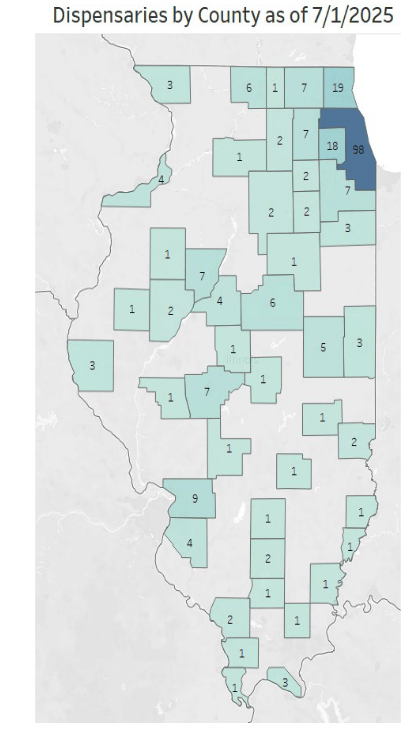
IDFPR also highlighted the launch of METRC, a new seed-to-sale system to be used by the state, its cannabis businesses, and members of the public. The report mentioned that the implementation of METRC will “enter its post-launch phase with additional enhancements and improvements for licensees and consumers, increasing transparency into the cannabis supply chain.”
The post-launch phase may include features like the Metrc patient portal I recently reported on. According to Vaughn Bentley, Deputy Director of Cannabis Control at IDFPR, the portal would allow medical patients to check purchase history, remaining allotment, and other account details without contacting a dispensary.
Illinois Department of Agriculture
The Illinois Department of Agriculture (IDOA) oversees everything outside of dispensaries — including cultivation centers, craft growers, infusers, transporters, and testing laboratories. IDOA also oversees a cannabis vocational training pilot program with community colleges.
IDOA detailed their goals and projects for 2026. The primary goal for 2026 is to fully staff and validate that laboratory for the Bureau of Cannabis Testing. You can read more information that I’ve gathered on the Bureau by clicking here.
“IDOA has 1 Craft Grower that shares premises with 1 Dispensary however the Craft Grower is non-operational for FY25.”
Excerpt from IDOA’s section of the Illinois 2025 Annual Cannabis Report
One detail I found particularly notable was the mention of a dispensary that shares a location with a craft grower.
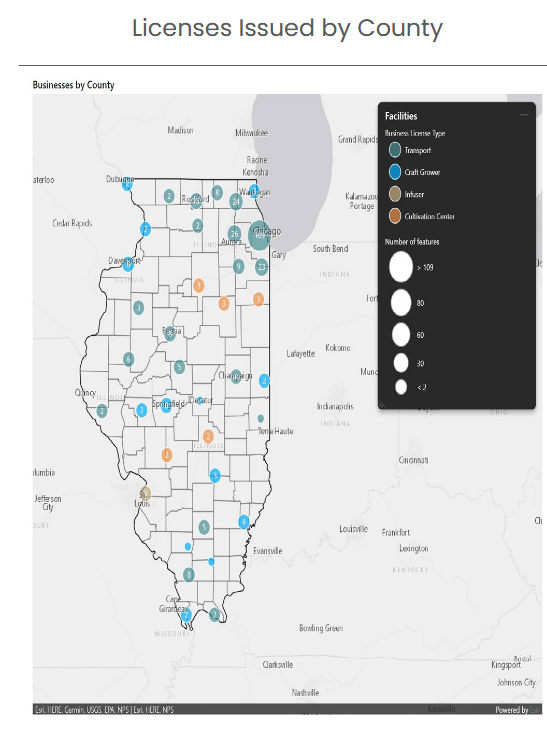
At the time of this report, the Department has issued licenses for: 21 Adult Use Cultivation Centers, 87 Craft Growers, 55 Infusers, 164 Transporters, and 9 approved Cannabis Community College Vocational Pilot Program participants. Of those licensees, 21 Craft Grow licensees are operational, as well as 16 Infuser licensees, with dozens more of each license type engaged in the buildout of their facilities. The Department has also registered 6 cannabis testing labs.
Of the 87 Craft Grow Licenses, 87 were issued to Social Equity Applicants. Of the 55 infusers, 54 of the licenses were issued to Social Equity Applicants. Of the 164 Transporters, 139 of the licenses were issued to Social Equity Applicants.
Excerpt from IDOA’s section of the Illinois 2025 Annual Cannabis Report
The report lists 87 issued craft grow licenses. In the past, IDOA press releases and reporting by outlets like WGLT.org have cited a total of 88. At the time of this writing, the state’s website currently lists the total number of licenses at 86.
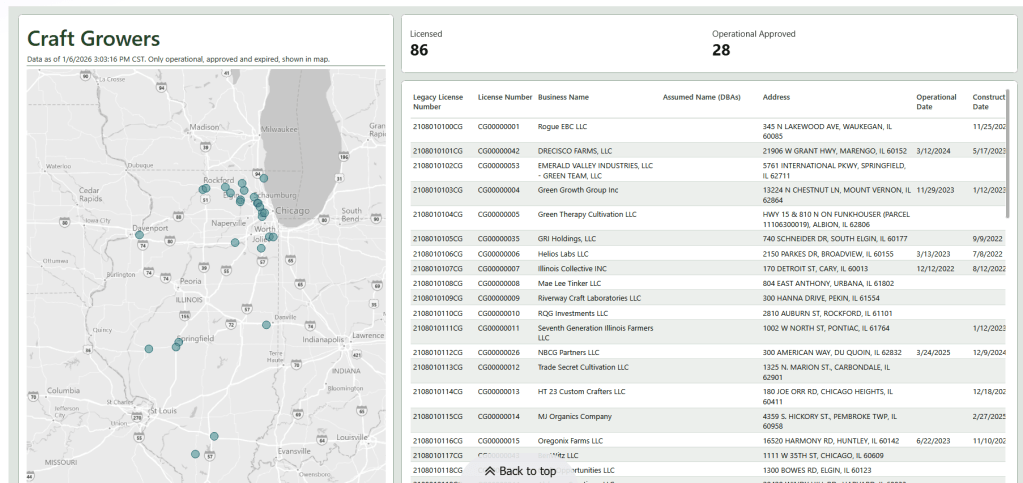
Click to see IDOA press release that lists total of craft licensees at 88
Illinois State Police
The Illinois State Police (ISP) provide “enforcement, investigation, and processing of all cannabis-related criminal offenses.” This includes curbing illicit market activity, defined as non-taxed sales and possession, enforcing laws related to driving under the influence, and overseeing security requirements within the legal cannabis industry.
Through its Cannabis Control Office (CCO), the agency conducts monthly inspections of all facilities operating under Illinois’ adult use and medical cannabis laws. The office also reviews physical security plans for both new and existing cannabis facilities.
Drug policy discussions in Illinois typically include the Illinois State Police as a major stakeholder in the legislative process. In 2025, the agency conducted 14 legislative bill reviews related to cannabis, psilocybin, and hemp.
Data on the Continued Criminalization of Cannabis in Illinois
Illinois released two reports in 2025 that include data on the continued criminalization of cannabis in Illinois. The annual cannabis report includes statewide arrest data that, in some cases, reflects only Illinois State Police activity, while the Adult Use Cannabis Health Advisory Committee’s 2025 report provides additional data on arrests by local law enforcement. Both reports are available here.
Enforcement Patterns
The criminal justice section of the 2025 Annual Cannabis Report from the Adult Use Cannabis Health Advisory Committee includes data on Cannabis Control Act (CCA) enforcement and incarceration outcomes. According to the report, 57.5% of those incarcerated for Cannabis Control Act were Black or African American, compared with 28.7% who were White.
Enforcement in Chicago
The report describes Chicago as a major hub for drug trafficking in the Midwest, citing its central geographic location and extensive transportation infrastructure. According to the report, high-potency cannabis cultivated in other states is routinely smuggled into the Chicago HIDTA region through commercial trucks, personal vehicles, and parcel shipments, where it is sold into Illinois’ illicit market.
The report further notes that Chicago-based gangs dominate much of the region’s illicit retail cannabis market and maintain a presence across the Midwest and nationally.
The data shows that cannabis enforcement in Illinois remains geographically and racially concentrated, particularly in Chicago communities that lack dispensaries.
“Notably, the opening of new dispensaries in 2024 does not appear to have influenced the spatial pattern of arrests. Communities with the highest concentration of arrests had little to no legal market presence, underscoring ongoing geographic and racial
disparities in post-legalization enforcement.”Excerpt from the Adult Use Cannabis Health Advisory Committee 2025 Annual Cannabis Report
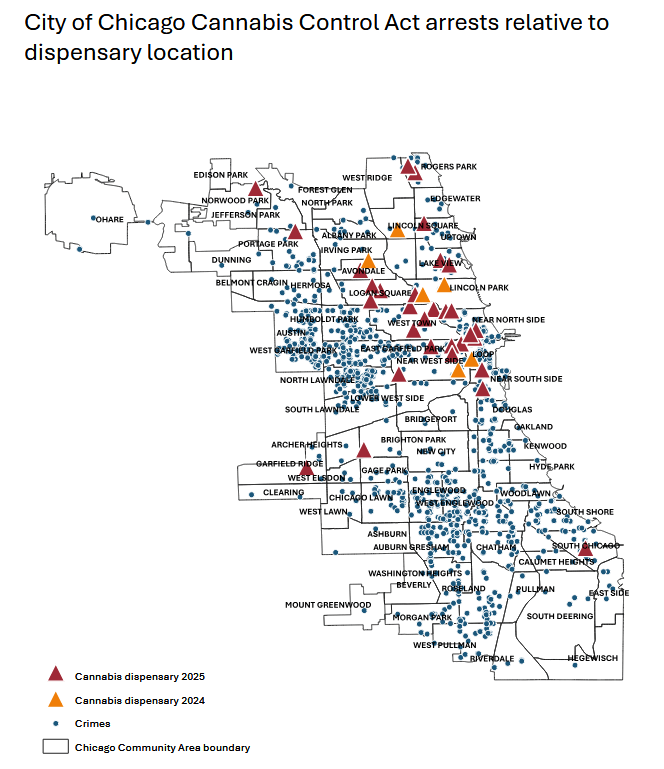
In Chicago, arrest patterns shifted notably in 2024, particularly for higher-quantity cannabis offenses. Arrests for possession of more than 30 grams rose from 492 to 647, a 31 percent increase. Arrests for manufacture or delivery involving more than 10 grams increased even more sharply, climbing from 399 to 716, a 79 percent increase. These cases now represent the most common cannabis-related charge in the city.
At the same time, arrests for manufacture or delivery of 10 grams or less fell from 41 to 27. Arrests for possession of 30 grams or less also declined by 19 percent, from 390 to 316.
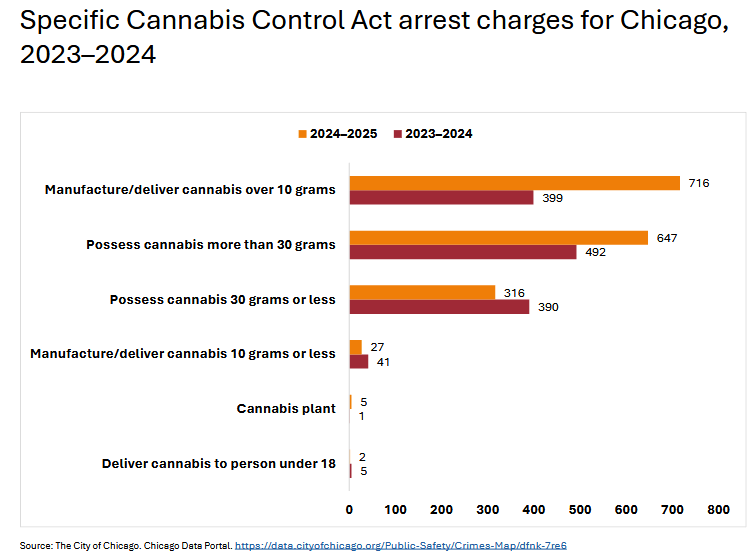
“Cannabis arrests in Chicago are increasingly concentrated in cases involving larger quantities and alleged intent to distribute. While low-level possession arrests continue to decline, enforcement remains active—particularly for higher-weight possession and delivery offenses—suggesting that legalization has not fully eliminated cannabis-related criminal enforcement in the city.”
Excerpt from the Adult Use Cannabis Health Advisory Committee 2025 Annual Cannabis Report
Violations of the Cannabis Control Act
The Illinois Cannabis Control Act (CCA) became law in 1978 and has since served as the state’s primary criminal statute governing cannabis possession, cultivation, manufacturing, and distribution. When Illinois passed the Cannabis Regulation and Tax Act (CRTA) in 2019, the state did not repeal the CCA. Instead, the CRTA created a regulated legal market while leaving the CCA in place to govern unlicensed activity, meaning legalization narrowed, but did not eliminate, cannabis-related criminal enforcement.
“Illinois law currently requires Illinois cannabis dispensaries to sell cannabis obtained solely from an authorized Illinois cultivation center or craft grower. However, the illicit cannabis marketplace remains unregulated. At the street level, it is difficult for local law enforcement officers to determine the actual source of cannabis in the possession of consumers. According to the Zone’s Task Forces and MEG Units, the average cost of illicit cannabis flower per ounce is $200 and $2,500 per pound.”
Excerpt from ISP’s section of the Illinois 2025 Annual Cannabis Report
Cannabis Control Act arrests in Illinois declined sharply between 2016 and 2021, falling from more than 33,000 arrests in 2016 to just over 5,000 by 2021. The steepest reductions occurred when Illinois decriminalized the possession of small amounts of cannabis in 2016.
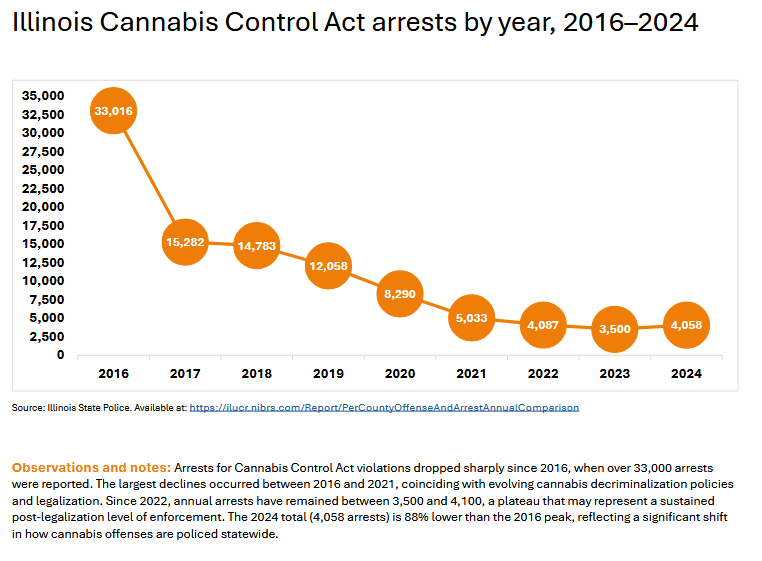
Following the passage of the CRTA, arrest totals did not continue to fall at the same pace. Instead, arrests stabilized beginning in 2022, fluctuating between roughly 3,500 and 4,100 per year.
In 2024, Cannabis Control Act arrests increased to 4,058, marking the first year-over-year increase since arrests leveled off after 2021. Overall, Cannabis Control Act arrests in 2024 remained approximately 88 percent lower than their 2016 peak.
“The ISP Investigative Zones seized approximately 16,738,186 grams (approximately 36,901 pounds or 18.5 tons) of illicit cannabis, including 14 cannabis plants, with an estimated street value of $251,072,790 and recovered 204 firearms in FY25…14 illicit cannabis plants were seized, which at harvest, can yield up to one pound of cannabis “buds” per plant.”
Excerpt from ISP’s section of the Illinois 2025 Annual Cannabis Report
Odor-Proof Cannabis Packaging
According to the report, ISP continues to train officers to identify and enforce cannabis impairment in order to protect public safety, emphasizing the role of on-scene observations in DUI investigations. The agency maintains that retaining the authority to consider cannabis odor and evidence of unlawfully transported cannabis as probable cause is critical to assessing impairment and identifying criminal activity.
“Following decriminalization on January 1, 2020, ISP temporarily paused imprinting new canines with the odor of cannabis to evaluate how evolving legislation and court rulings would affect their deployment. This proactive approach prevented the need to replace large numbers of canines at once and preserved flexibility should future rulings favor or restrict cannabis-imprinted canines. Today, ISP supports a canine section of nearly 70 canines—some imprinted with cannabis and some not—ensuring the Department remains adaptable while closely monitoring the legal landscape.”
Excerpt from ISP’s section of the Illinois 2025 Annual Cannabis Report
The report states that shifting judicial interpretations and legislative changes could limit the Division of Patrol’s ability to use odor detection and canine teams, which ISP describes as key tools for intercepting trafficked drugs.
The Division of Patrol analyzed the potential public safety impacts of Senate Bill 42, introduced in the Illinois 104th General Assembly. The bill proposed amending the Illinois Vehicle Code by eliminating the requirement that cannabis be transported in an odor-proof container and prohibiting vehicle stops or searches based solely on the odor of cannabis.
According to ISP, passage of SB42 would have significantly restricted enforcement authority related to cannabis detection and impaired driving. The agency reports that it continues to monitor legislative proposals it believes could affect enforcement capabilities.
I’ve previously covered this legislation in depth, I’ve interviewed the bill’s sponsor, and I’ve published several articles and interviews on the subject, featuring legal analysis from licensed attorneys and more.
Click to see articles/interviews that I’ve published on the subject of SB42.
- Criminal Law Committee in the Illinois Senate Votes to Advance Bill to Ban Vehicle Searches Based on Smell of Cannabis
- Illinois Police and Cannabis Operators Oppose the Cannabis Omnibus
- Episode 172 – I testified against police
- Illinois Supreme Court Upholds Odor-Proof Cannabis Container Law
- Podcast episode with lawyers where we recap Supreme Court rulings on cannabis container
- Odor Proof scene from Mini Doc
- 12:38~14:45
- Episode 213 – Odor Proof Updates + Metrc’s impact on Illinois Medical Cannabis Patients
- Episode 199 – Cannabis Odor Bill Moves Forward but a “Compromise” Could Weaken It
- The proposal that I discussed in this ultimately did not come to fruition
- Cannabis Odor Search Ban Advances in Illinois, but a “Compromise” Could Undermine Its Intent
- The proposal that I discussed in this ultimately did not come to fruition
- Episode 190 – Help End Cannabis-Odor-Based Vehicle Searches in Illinois
- Episode 184 – Breaking: Illinois Senate Advances SB42 to Curb Vehicle Searches Based on Cannabis Odor
- Illinois Senate Advances Bill to Curb Cannabis-Based Traffic Stops, House Consideration Up Next
- After Objections, CPD Agrees Officers Will Not Search Vehicles Based on Smell of Raw Cannabis: Reform Groups
Destruction of Cannabis
The report also details activity by the Scene and Evidence Services Command. During FY25, approximately 10,720 pounds of illicit cannabis were transported to Veolia Environmental Services in Sauget, Illinois, for destruction.
According to the report, no Cannabis Control Office funds were used for this effort. However, the use of CCO funding is being explored as an option for future large-scale cannabis destructions.
Changes in Expungement Tracking
While expungements for minor cannabis offenses have not stopped, according to the report, the state has largely stopped tracking them. Beginning in fiscal year 2024, counties stopped submitting court orders that specifically identify minor cannabis cases. Instead, those cases are now grouped with non-cannabis expungements in more general court orders.
As a result, the Illinois State Police report that they can no longer comprehensively record or report the number of minor cannabis records being expunged. Under the current reporting structure, the cannabis-specific expungement figures included in the annual report will remain unchanged unless counties resume submitting cannabis-specific court orders.
In short, while expungements may still be occurring, the state can no longer reliably report how many cannabis-related records are actually being cleared.
The report states that no new omnibus expungement orders were received in 2025 through either the Governor’s Pardon process or the State’s Attorney vacate process. According to ISP, previously submitted omnibus orders from 64 counties have already been fully processed, with each process representing the equivalent of roughly 11,000 individual court orders.
Inspection Data from ISP’s Cannabis Control Office
According to the report, the Cannabis Control Office conducted 7,568 inspections at licensed cannabis facilities statewide during FY25, including cultivation centers, dispensaries, craft growers, infusers, and transporters. State police data shows that out of 1,145 under-21 covert compliance details, only four resulted in illegal sales to minors.
The majority of CCO inspectors are former law enforcement officers and have completed the mandatory training required for the role, along with additional training mandated throughout the year by the Illinois State Police. During FY25, the CCO was approved to add six additional Illinois State Police inspectors, who will replace existing contractual inspectors. The office plans to continue transitioning away from contractual inspectors in FY26.
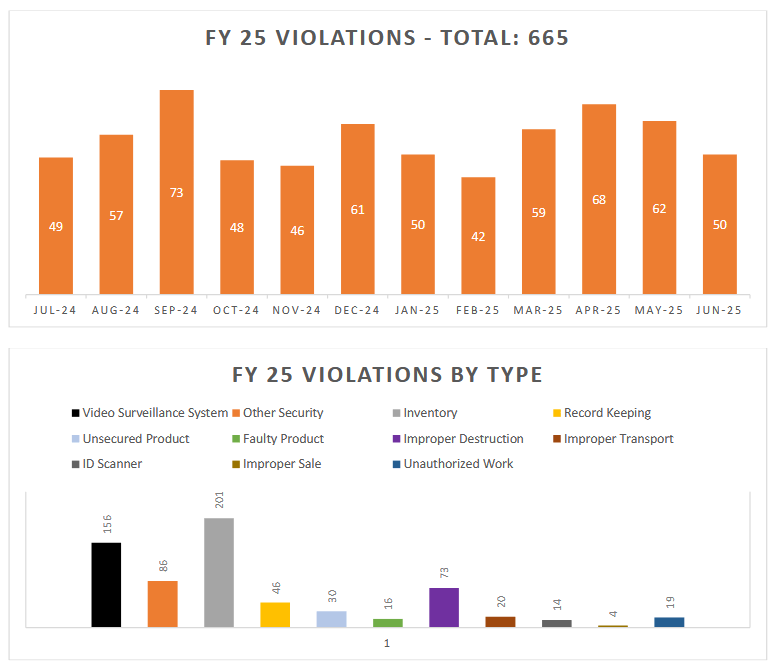
In total, inspectors identified 665 violations in FY25.
More to Come
I’ll be sharing additional takeaways from these reports in the coming days.
You can watch me discuss this article in more detail here, and I’ll link to any future analysis below as it’s published.
Comment below with your thoughts and consider supporting my work!
You can support The Cole Memo with a one-time, monthly, or yearly contribution.
Support The Cole Memo by making a one-time contribution
Support The Cole Memo with monthly contributions
Support The Cole Memo with yearly contributions
Choose an amount
Or enter a custom amount
Your contribution is appreciated. Your contribution helps us afford equipment to capture our content and hosting fees to distribute our content.
Your contribution is appreciated. Your contribution helps us afford equipment to capture our content and hosting fees to distribute our content.
Your contribution is appreciated. Your contribution helps us afford equipment to capture our content and hosting fees to distribute our content.
DonateDonate monthlyDonate yearly
#270 – Illinois Licensing Case Heads to Court + Big Personal Announcement – The Cole Memo
- #270 – Illinois Licensing Case Heads to Court + Big Personal Announcement
- #269 – Inside Springfield: How Lobbying Really Works
- #268 – Cocaine Cash in Illinois? + Latest Cannabis Policy Updates
- #267 – Illinois Odor Laws, Hemp Ban Pushback, Indiana Eyes Legalization
- #266 – The UIC Lab Scandal and Cannabis Law Confusion in Illinois
 The Cole Memo
Leave a comment