
Yesterday I attended a meeting with the Medical Cannabis Advisory Board, a body that makes recommendations to the Illinois Department of Public Health on additions to the list of qualifying conditions for the medical cannabis program. At this meeting, representatives from several cannabis-related state agencies gave presentations about their roles, work, and what patients & consumers might expect in the future.
During the discussion, board members asked if the state would provide the presentations for public review. I asked the same question during the public comment period.
Officials explained that they would follow up with the individual presenters to determine whether the documents could be shared directly. Officials seemed to indicate that if permission is granted, the presentations will be attached to the meeting minutes or distributed in some fashion by Illinois Department of Public Health; otherwise, the public will be informed on how to request the presentations directly from the agencies.
In this article, I’ll share updates from each department, highlighting the points that may be most notable for patients, consumers, and the general public.
- Illinois Department of Public Health (IDPH)
- Illinois Department of Financial and Professional Regulation (IDFPR)
- Illinois Department of Agriculture (IDOA)
- Cannabis Regulation Oversight Office
- When is the next meeting?
Illinois Department of Public Health (IDPH)
IDPH reported that it is continuing to refine the new patient registration platform, with another round of bug fixes scheduled to roll out in the coming days.
Officials also reminded attendees that January is the window for submitting petitions to add new qualifying conditions to the medical cannabis program. Patients or advocates with questions were directed to contact Eva-Janette Candido (Eva-Janette.Candido@Illinois.gov), the division chief for medical cannabis, Melissa Stalets (Melissa.Stalets@Illinois.gov), or IDPH staff directly (DPH.MedicalCannabis@illinois.gov).
Petition Window for New Qualifying Conditions
At the close of the meeting, officials reminded attendees that petitions to add new qualifying conditions to Illinois’ medical cannabis program must be submitted between January 1 and January 31, 2026. Submissions cannot be accepted beforehand, and applicants were encouraged to prepare thoroughly and organize their materials in advance, as the state must review and sort through all supporting literature during this limited one-month window.
Illinois Department of Financial and Professional Regulation (IDFPR)
Vaughn Bentley, Deputy Director of Cannabis Control at IDFPR, explained that the agency oversees licensing for dispensaries and their employees, approves staff training programs, and enforces compliance to protect public health and safety. Illinois currently has 263 licensed adult-use dispensaries, but only 55 of them are authorized to serve medical patients. Those 55 locations were originally issued in the medical cannabis pilot program that launched around 2014.
Vaughn explained that the original 55 medical dispensary licenses from 2014 have remained the same, though some have changed location or ownership. The total number has not increased since the program began, and expanding to add more medical dispensaries would require a change in state law.
Bentley addressed how Illinois awards new dispensary licenses. Because the number of licenses is capped by statute, the state uses a lottery system, which he described as the most equitable way to distribute opportunities. The lottery process has not been without controversy. Previous lotteries drew criticism and even legal challenges, with outlets like Grown In and others reporting on confusion, delays, and concerns from applicants about fairness and transparency.
For consumers, IDFPR highlighted several changes already in place. Curbside pickup for medical patients, which began as a temporary measure during COVID-19, is now a permanent option at dispensaries. Bentley mentioned that new adult-use and medical dispensary rules took effect “in the last year or so”, aimed at improving transparency, safety, and the customer experience. Bentley did not specify which rules he was referencing in this part of his update.
Vaughn also shared that updated training requirements for dispensary staff are rolling out this year. Additionally, the state has transitioned to Metrc, a new seed-to-sale tracking system that, despite initial challenges, is expected to improve communication and transparency across the market.
“The transition, as I’m sure everyone on this call knows, has not been fully smooth or free of issues, but it has resulted in increased transparency, better communication between the industry and consumers, and a number of steps forward for dispensaries.”
Vaughn Bentley
Looking ahead, IDFPR is implementing a new licensing system called Core, designed to streamline the application process.
For patients, one of the most significant upcoming changes is the launch of a Metrc patient portal. This tool will allow medical patients to check their purchase history, remaining allotment, and other account details without needing to call or visit a dispensary. Bentley also emphasized that IDFPR is working with lawmakers to expand access for patients by allowing them to shop at any dispensary statewide while still receiving the medical tax rate and higher allotment benefits.
In response to public questions, Bentley noted that the agency cannot mandate more CBD-rich products or set prices and inventory, though competition may naturally stabilize those issues over time.
It’s worth noting that the Illinois Department of Agriculture has allowed two growers in the state to cultivate “CBD Cannabis,” or “low-THC strains of cannabis” otherwise known as hemp.
“We did receive two additional questions on how to make inventory and prices more reasonable and consistent from dispensary to dispensary. We largely are not able to set prices or inventory levels. That said, what we have seen in other industries is that with increased competition, prices tend to stabilize and consistent offerings tend to be found across the board. So we are pushing forward, as I said, with that legislation and attempting to pass legislation that would allow medical patients to shop at any dispensary. But outside of those efforts, there’s not much we can do.”
Vaughn Bentley
Vaughn acknowledged that it can be difficult to tell which dispensaries are medical versus adult-use-only but pointed to the state’s website, which publishes updated lists of dispensary locations. On banking, Bentley said the agency is coordinating with the state’s Division of Banking and following federal efforts on the SAFE Banking Act to expand financial services for dispensaries.
Takeaway for Patients
While patients are still limited to the original 55 medical dispensaries for their tax break and allotment benefits, IDFPR is actively pursuing legislation to expand access, and in the near future, patients will gain more control over their own records through a new online portal.
A quote from the brief Q&A:
“Why can medical patients not go to any cannabis dispensary and use their medical cards for the tax break? That would require a statutory change.
It is something we are actively working towards. Every year it is in our proposals and we have brought language to both the Senate and the House previously, and we are continuing to work to push that forward.”
Vaughn Bentley
Comments from Board
After Bentley’s presentation, longtime medical cannabis advocate Jim Champion offered a pointed comment. Champion, a veteran and the first registered patient in Illinois’ medical cannabis program, was also among the earliest public advocates for patient access, pushing for reform even before the state’s first cannabis law passed.
“I would like to say that I started working on this bill to pass it back in 2008. I worked on it and have been working on it ever since then. And the fact that we have only 55 dispensaries licensed for medical and 208 for adult use is not only neglectful, it’s embarrassing that we have just been…and you keep saying that “we’re the bedrock”… and we should be the bedrock because historically there are no [adult use] cannabis programs in the United States without first being a medical cannabis program. And as a patient, I will say that it feels like they rode our back to get here, and now we are stuck back…we’re still dealing with the 2014 dispensaries.
I have personally been working on getting the dispensaries, getting the regulations changed in Springfield, and we’ve been working on opening up the dispensaries to medical patients longer than we worked on the original medical cannabis bill itself. And it is embarrassing, and I think that the state of Illinois, this medical cannabis program, the governor…everybody should be embarrassed.
As patients, that’s why we feel neglected, because there’s too much ‘we can’t do this’ and ‘we can’t do that,’ and we’re still living by 2014 rules. I have been working so hard to open up these new regulations, but every year it gets passed off and passed off, and now the bill has been passed off again by the speaker. So that’s more of a comment than a question, but do with it what you may”
Jim Champion
Illinois Department of Agriculture (IDOA)
David Lakeman, who heads the Division of Cannabis Regulation at the Department of Agriculture, explained that his agency oversees everything outside of dispensaries — including cultivation centers, craft growers, infusers, independent transporters, and testing laboratories.
Since 2019, the department has issued 362 licenses across these categories. That total includes the original 21 large-scale cultivation centers first licensed in 2014 under the state’s medical cannabis pilot program, along with 88 craft growers, 54 infusers, and 189 transporters.
David also mentioned that IDOA runs a cannabis vocational training pilot program with community colleges, designed to build a workforce trained in Illinois rather than out of state, and to provide opportunities as surrounding states expand their own cannabis industries.
Bureau of Cannabis Testing
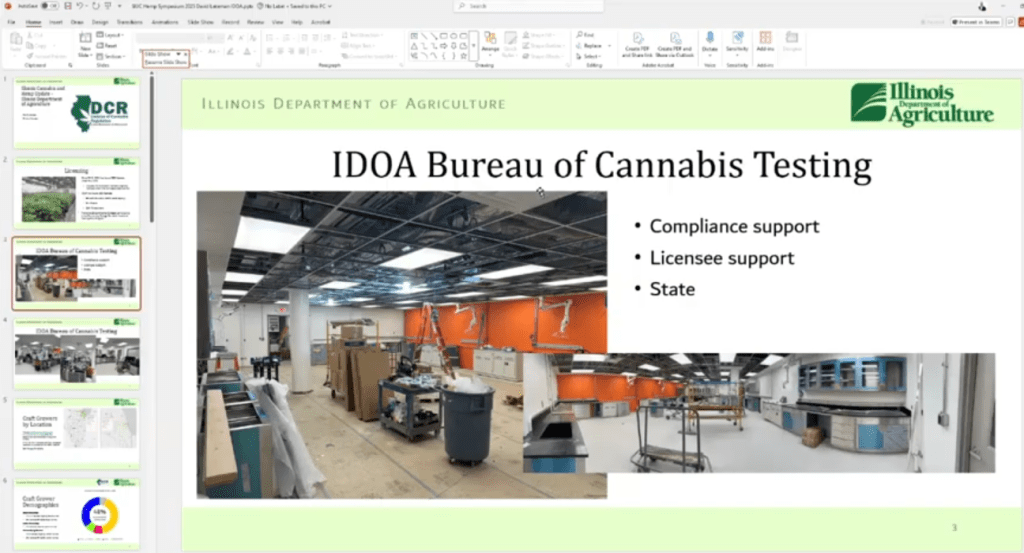
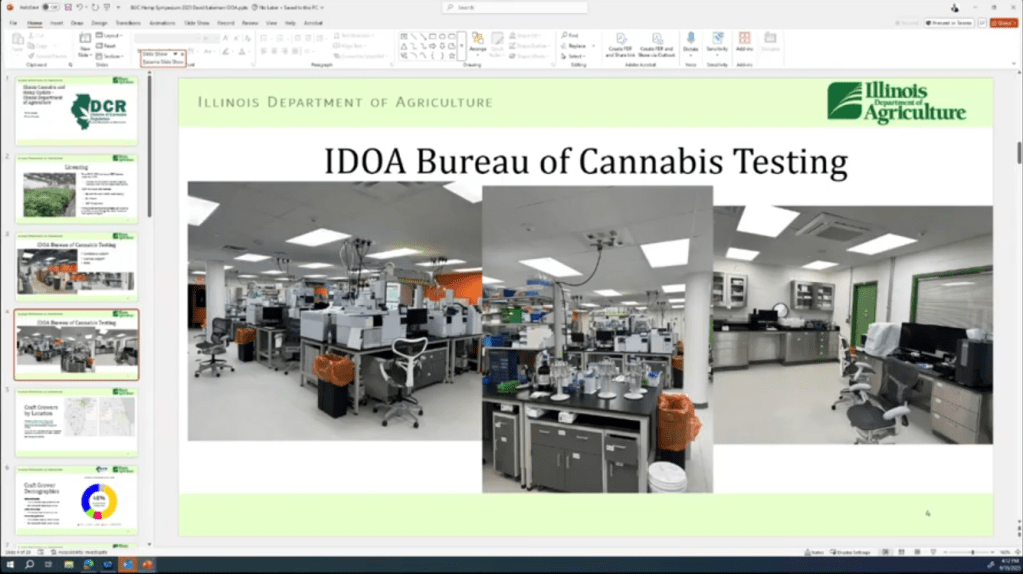
Lakeman highlighted the launch of the state’s new Bureau of Cannabis Testing, one of the first state-run cannabis reference labs in the nation. Built inside a repurposed former animal disease lab, the facility is expected to be fully accredited and operational in the first quarter of next year. The lab will allow IDOA to conduct its own testing with full chain of custody, respond directly to complaints, and oversee the accuracy and methods of private testing labs. Lakeman emphasized that consistent and reliable testing is a cornerstone of a safe and legal cannabis market, especially as concerns about “lab shopping,” where operators seek out labs that produce favorable results, have surfaced in other states.
“So as complaints come to us or if there are issues, we’re able to investigate those and do that testing in house and have full chain of custody. It also allows us to serve as both a better resource and you know it serves us as the regulator for the independent testing laboratories in the state to be sure that their methodology is good, that the structure they’re approaching things with is good, that we are getting consistent results, being aware of some of the lab shopping issues that have impacted other legal states. We want to be sure that we are staying ahead of that and again providing both a resource to the industry as well as a regulatory tool for ourselves and making sure that that product is safe and well tested. It is our firm belief that safe testing is a cornerstone. It is foundational to a legal industry whether it be medical or adult use and we want to be sure that we are meeting our obligations there and doing our best to meet that mission.”
David Lakeman
Below are images of the lab that David shared during his presentation.
Hemp
Turning to hemp, Lakeman described Illinois’ regulatory framework under the federal 2018 Farm Bill and USDA rules, which the state finalized last year. According to David’s presentation, Illinois has 77 licensed hemp growers and 169 processors cultivating roughly 3,635 acres. He also gave historical context, noting that Illinois grew more than 40,000 acres of hemp during World War II under the federal “Hemp for Victory” program, and emphasized that the state’s climate and soil make it a particularly good place to grow hemp.
Click to see hemp growing naturally in Illinois
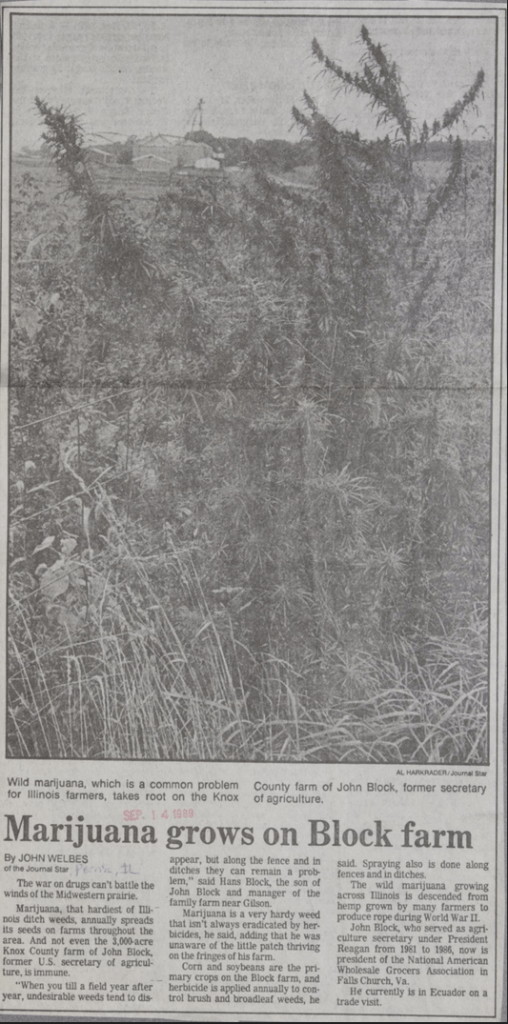
Decades ago, cannabis was grown outdoors on John Block’s farm (see photo below from the Illinois history archive I created). Today, the Illinois Division of Cannabis Regulation at IDOA, overseen by David Lakeman, is headquartered in the John Block Building.
Lakeman said the department is actively working with the governor’s office, lawmakers, and partner agencies to update hemp rules, with an emphasis on ensuring consumer safety around “intoxicating hemp products”.
“The primary thing that science has now also delivered is the potential for intoxicating cannabinoids within hemp. The department has been engaged with the governor’s office, with the administration, with our partner agencies on this meeting, as well as the legislature, on finding potential pathways forward on ensuring that those products are safe for the consumer as well.”
David Lakeman
The measure, which had support from the Governor, would have sharply increased the penalties for cultivating, processing, or selling cannabis flower, concentrates, and infused products within Illinois. The legislation proposed $10,000 daily fines in addition to the existing criminal penalties outlined in the Illinois Cannabis Control Act of 1978 for “unlicensed practice” with cannabis.
Takeaway for Patients and Consumers
During the Q&A, Lakeman noted that any consumer can currently request a certificate of analysis (COA) at the time of purchase, and dispensaries are required to provide it.
Vaughn Bentley followed up by explaining that IDFPR is developing functionality within the Metrc system to make COAs easier to access through a QR code printed on product packaging, allowing consumers to scan and view the certificate without having to ask for it.
Cannabis Regulation Oversight Office
Nathaniel Inglis Steinfeld, Research and Data Deputy at the Cannabis Regulation Oversight Office (CROO), explained that his office serves as a coordinating body across all the state agencies that regulate cannabis.
CROO does not have statutory authority to license or enforce regulations; instead, it focuses on connecting the work of agencies like IDPH, IDOA, and IDFPR, advising on policy, and bringing together data to provide a clearer picture of how Illinois’ cannabis system functions. The office also has a mandate to promote diversity and equity in the industry while supporting the medical program.
CROO maintains the state’s cannabis website, cannabis.illinois.gov, which consolidates information from multiple agencies. Among its tools is an interactive map showing all dispensaries in the state, with medical dispensaries clearly marked. Steinfeld noted that while some adult-use dispensaries offer discounts to patients who show their medical card, this is not the same as using the official medical system, which is the only way patients can avoid higher taxes and have purchases count toward their medical allotment.
“I think Illinois is unique in that our medical program maintains a healthy set of patients who are buying product and engaging across our dispensaries. It’s interesting to put that in a national context and connect data and information that can help answer questions and provide data-driven ideas to stakeholders such as the Medical Cannabis Advisory Board.”
Nathaniel Inglis Steinfeld
He also shared data on cannabis tax revenue. In fiscal year 2025, Illinois collected $281 million in adult-use cannabis taxes, which were deposited into the Cannabis Regulation Fund and distributed based on allocations set by the legislature. (Medical cannabis sales are not taxed the same way and are not included in this figure.) CROO analyzes these numbers in partnership with the Department of Revenue and posts updates to its website.
As part of its data work, CROO publishes insights into how medical patients use the market. For example, Steinfeld pointed out that medical patients account for the highest percentage of sales of Rick Simpson Oil (RSO) compared to other product categories. He noted that product data categories are shifting as the state transitions to Metrc, the new seed-to-sale tracking system, but CROO continues to distill this information into reports that may be useful to policymakers, medical providers, and patients.
During the Q&A, a board member suggested that CROO could survey patients to better understand their barriers to care and experiences with the medical program, noting that the office has access to the full patient list. Steinfeld responded that such efforts would need to involve IDPH, since the patient registry falls under their authority. He explained that CROO’s role is to coordinate statewide policy rather than directly manage the registry, but added that his office is familiar with surveys, pointing to a recent diversity survey they conducted within the cannabis industry that gathered feedback from licensees and employees, including their interactions with the medical program.
I hosted a podcast with a medical professional who has since joined the Medical Cannabis Advisory Board. In that episode, we discussed in detail the many challenges facing Illinois’ medical cannabis program.
You can listen to or watch the episode here.
Steinfeld also added to Bentley’s earlier comments about certificates of analysis (COAs). He explained that Metrc has a consumer portal that Illinois is currently testing to ensure it works properly and complies with state law. The portal would allow consumers to view all products available in Illinois dispensaries, with COAs attached for direct access. Steinfeld pointed to Massachusetts as an example of a state already using a similar system and said the feature could launch “in the next month or so,” though he cautioned, “don’t quote me on that.”
Takeaway for Patients and Consumers
CROO does not directly license or regulate dispensaries but serves as a hub for information, data, and coordination across agencies. Patients can use the state’s official cannabis website to verify which dispensaries are licensed for medical sales, and future reports may offer clearer insights into product trends, equity efforts, and how tax dollars are spent.
Steinfeld also noted that Illinois is testing Metrc’s consumer portal, which would allow shoppers to see all products available in dispensaries with COAs attached for direct access. If implemented, this system could give consumers a new level of transparency when choosing products, though Steinfeld cautioned that the launch timeline remains uncertain.
When is the next meeting?
According to the agenda, which you can view below, the next meeting of the Medical Cannabis Advisory Board will be on February 9, 2026, 3:30-5:00 (or may be scheduled at the call of the Chair).
If you would like to provide public comment, please note the following procedures:
- Time allotted: 20 minutes total will be reserved for public comment.
- Order of speakers: Individuals will be called in the order in which they register.
- Speaking time: Each speaker may speak for up to three minutes.
- Registration: Persons who wish to register to speak must do so in advance.
- Persons who wish to register to speak may contact Janette Candido at Eva-Janette.Candido@Illinois.gov.
Comment below with your thoughts and consider supporting my work!
You can support The Cole Memo with a one-time, monthly, or yearly contribution.
Support The Cole Memo by making a one-time contribution
Support The Cole Memo with monthly contributions
Support The Cole Memo with yearly contributions
Choose an amount
Or enter a custom amount
Your contribution is appreciated. Your contribution helps us afford equipment to capture our content and hosting fees to distribute our content.
Your contribution is appreciated. Your contribution helps us afford equipment to capture our content and hosting fees to distribute our content.
Your contribution is appreciated. Your contribution helps us afford equipment to capture our content and hosting fees to distribute our content.
DonateDonate monthlyDonate yearly
#261 – Recapping Governor Pritzker’s Address with Jeremy Gorner – The Cole Memo
- #261 – Recapping Governor Pritzker’s Address with Jeremy Gorner
- #260 – Chicago Vetoes Hemp Ban, Illinois marijuana news, featuring Jeremy Gorner!
- #259 – MSOs Get Sued, Outdoor Grow Quietly Allowed in Illinois, What Illinois Got Wrong With “Legalization”, + More
- #258 – The Reality of Being a Craft Grower in Illinois
- #257 – Illinois Cannabis Sales Drop as Lawmakers Revisit Search Rules
 The Cole Memo
Leave a comment