
Earlier this week, the ATF, working with the U.S. Marshals Service, conducted raids across Arizona, Florida, Georgia, Illinois, New Jersey, and North Carolina.
In April, the U.S. Supreme Court upheld the FDA’s ban on the sale of unauthorized flavored vapes, citing concerns they could encourage youth tobacco use. By August, Attorney General Pam Bondi directed the ATF to proceed with a planned enforcement operation, following Health Secretary Robert F. Kennedy Jr.’s designation of illicit vaping products shipped from China as a top priority.
These raids prompted a question to Illinois Gov. JB Pritzker, who used the moment to stress his concerns about hemp products, particularly their impact on children. He warned that, absent legislative action, he may resort to executive authority to act on the subject.
A similar debate has been playing out in Texas. With lawmakers deadlocked on the long-term future of hemp-derived THC, Texas Governor Greg Abbott recently issued an executive order to require mandatory ID checks for every THC transaction. Abbott framed the action as a necessary step to protect children, saying, “Safety for kids, freedom for adults.” His move has drawn praise from parts of the hemp industry that support age restrictions, even as policymakers continue to argue over whether broader regulation or a full ban is the best path forward.
These mark the first statements that Governor Pritzker has made on the topic since the debate hit a boiling point in January. Just a month earlier, Pritzker appeared alongside cannabis regulators, lawmakers, the CEO of a candy company, and others to endorse a bill that critics argued would effectively ban all hemp-derived legal THC (HDLT) products from being sold anywhere except the state’s limited number of licensed dispensaries.
The Illinois cannabis market is now over a decade old. For many cannabis consumers, the accessibility provided by these federally-legal hemp products has been a refreshing alternative in a state known for its restrictive and overpriced cannabis market.
The Pritzker-backed measure would have sharply increased the penalties for cultivating, processing, or selling cannabis flower, concentrates, and infused products within Illinois. The legislation proposed $10,000 daily fines in addition to the existing criminal penalties outlined in the Illinois Cannabis Control Act of 1978 for “unlicensed practice” with cannabis.
“These products are often shipped from out of state and are subject to no oversight or testing for biological contaminants or pesticides.”
On the Senate floor, Senator Kimberly Lightford, the bill’s lead sponsor, confirmed that the ban would not apply to online sales, leaving out-of-state retailers free to continue serving Illinois consumers. As written, the legislation Pritzker supported would have exclusively targeted local Illinois businesses.
The bill ultimately failed to advance in the General Assembly. Although it had cleared the Senate, House Speaker Chris Welch declined to call it for a vote after determining it lacked enough support among House members to pass.

A spokesperson for House Speaker Chris Welch recently issued a statement to Crain’s Chicago Business.
“The Speaker remains committed to promoting safety in this industry in a way that unites members of the House Democratic Caucus. If the governor has ideas as to how these goals can be met through existing law, we would welcome the opportunity to review those options as part of this discussion as well.”
Across the spectrum, there is general agreement that cannabis products, whether categorized as “hemp” or “marijuana,” should be restricted to adults 21 and over, tested for safety, and labeled clearly so that consumers know what they are buying.
If the distinction between “hemp” and “marijuana” feels confusing, it helps to remember that Cannabis is the scientific name of the plant and of the products derived from it. The terms “hemp” and “marijuana” are not botanical categories but arbitrary legal classifications created by federal law:
- Hemp: Defined by the 2018 Farm Bill as cannabis containing less than 0.3% Delta-9-THC on a dry weight basis. Hemp includes hemp-derived legal-THC (HDLT) products, which enjoy significant legal and regulatory advantages. These products are federally legal, as hemp and its cannabinoids have been removed from the Controlled Substances Act.
- Marijuana: Cannabis products with more than 0.3% Delta-9-THC, regulated under state-specific laws and still federally illegal under the Controlled Substances Act. In Illinois, products regulated under the Cannabis Regulation and Tax Act (CRTA) fall into this category.
The graphic below offers a clear explainer.
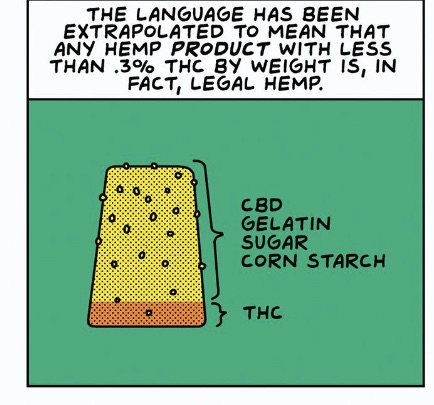
In the past, any product with any detectable amount of THC, the compound most commonly associated with the cannabis “high,” was considered illegal.
With the introduction of the legal category of “hemp,” products can now contain measurable amounts of THC, as long as the concentration does not exceed 0.3% of the product’s total weight. In practice, this means you can legally purchase items with 5–100mg of THC, which are truly identical to products sold in licensed dispensaries.
The real fault line is over how much competition should be allowed in the cannabis market. Illinois has one of the most restrictive frameworks in the country, centered on tightly limiting the number of licenses available.
Supporters of this approach, including many within the state’s licensed marijuana industry, argue that capping licenses helps avoid a race to the bottom, price compression, and bankruptcies. Regulators at the Cannabis Regulation Oversight Office (CROO) have said that a limited-license model is what shields Illinois’ market from these risks.
Governor Pritzker has echoed this sentiment, warning that if too many dispensaries were allowed, prices could drop so low that operators would struggle to stay profitable. By contrast, advocates of open competition believe licenses should not be capped at all and that consumers would be better served by a free-market approach.
It remains unclear how far Pritzker could act via executive order. Illinois’ cannabis regulations were established by statute, and many argue that any comparable framework for hemp-derived products would also require legislative approval.
At the very least, some suggest he could follow Governor Abbott’s recent example in Texas, and create a 21-and-over age restriction on THC-containing products, as a way to address concerns about sales to minors.
You can view Governor Pritzker’s full statement below.
As to the raid on the vaping manufacturers, I understand. All I can say is that remember what the vaping is about. It’s hemp manufacturing and usage. And I’m deeply concerned, I think some of you know, about intoxicating hemp in this state. And we are going to have to do something either legislatively or from the executive branch to stop the sale of intoxicating hemp without any regulation whatsoever in this state. It literally is making our children sick and it is a shame on legislators and on this state that we are not already doing something about it. We need help from the legislature to make it happen, or if not we may need to impose executive authority to try to shut those sales of intoxicating hemp down.
Governor JB Pritzker
Comment below with your thoughts and consider supporting my work!
You can support The Cole Memo with a one-time, monthly, or yearly contribution.
Support The Cole Memo by making a one-time contribution
Support The Cole Memo with monthly contributions
Support The Cole Memo with yearly contributions
Choose an amount
Or enter a custom amount
Your contribution is appreciated. Your contribution helps us afford equipment to capture our content and hosting fees to distribute our content.
Your contribution is appreciated. Your contribution helps us afford equipment to capture our content and hosting fees to distribute our content.
Your contribution is appreciated. Your contribution helps us afford equipment to capture our content and hosting fees to distribute our content.
DonateDonate monthlyDonate yearly
#270 – Illinois Licensing Case Heads to Court + Big Personal Announcement – The Cole Memo
- #270 – Illinois Licensing Case Heads to Court + Big Personal Announcement
- #269 – Inside Springfield: How Lobbying Really Works
- #268 – Cocaine Cash in Illinois? + Latest Cannabis Policy Updates
- #267 – Illinois Odor Laws, Hemp Ban Pushback, Indiana Eyes Legalization
- #266 – The UIC Lab Scandal and Cannabis Law Confusion in Illinois
 The Cole Memo
Leave a comment