
On Friday, May 9th, an Illinois House committee voted 8-6 to advance Senate Bill 42, a measure sponsored by Senator Rachel Ventura (D) and House Representative Curtis J. Tarver, II (D). If the original language of SB42 is passed into law, the legislation that would prohibit law enforcement from using the smell of cannabis—raw or burnt—as the sole reason to search a vehicle.
Despite the committee vote, Rep. Tarver made clear that SB42 is a work in progress. Throughout the hearing before the House Judiciary – Criminal Committee, Tarver repeatedly emphasized that the legislation is not final and committed to holding the bill on Second Reading to allow time for further negotiations and amendments.
“My goal, in the most ideal situation, is to move this to second, to hold it on second, and to continue to work with my colleagues and law enforcement,” Tarver told the committee, adding, “This bill is not the solution.”
Tarver cited recent rulings from the Illinois Supreme Court — one concerning the smell of burnt cannabis, the other relating to raw cannabis — that called for legislative clarity and greater consistency between the Cannabis Regulation and Tax Act and the state’s vehicle code. According to Tarver, the court “clearly is, to some extent, asking us to do something.”
- Read about the Illinois Supreme Court’s first ruling on this issue (People v. Redmond) here.
- Listen to legal professionals discuss the ruling (People v. Redmond) here.
- Read about the Illinois Supreme Court’s second ruling on this issue (People v. Molina) here.
- Listen to legal professionals discuss the ruling (People v. Molina) here.
According to the chairperson of the committee, Justin Slaughter, SB42 received more than 2,800 witness slips filed in opposition — compared to 538 in support — and sparked concerns from Republican members and law enforcement officials over public safety, trafficking, and impaired driving.
Rep. Patrick Windhorst (R) questioned whether moving to limit search authority before addressing existing gaps in DUI enforcement could worsen road safety outcomes. “My preference would be to resolve those intoxicated motorist issues before we start making changes to the cannabis statute in your direction,” he said, citing a reported increase in cannabis-related fatal crashes post-legalization.
Rep. Bob Morgan (D) acknowledged the national challenges around cannabis impairment detection but emphasized that the issue of probable cause — and the legal use of odor to justify searches — was distinct from that broader, unresolved debate. He noted that determining cannabis impairment is a scientific and legal issue still playing out nationwide and cautioned against expecting a quick resolution.
“This is something that has been a challenge for many, many years,” Morgan said, referencing his own work on the issue with law enforcement and fellow legislators. “It’s a scientific issue, one that we have not resolved as a country. And I don’t think we should have an expectation that Leader Tarver will solve that in the next coming weeks or years, because it’s complicated.”
Still, Morgan emphasized the urgency of addressing the racial disparities that persist under the current law. “It’s indisputable that Black and Brown drivers are dealing with this on a daily basis in a way that White drivers are not,” he said. “We’re gonna get this done.”
Rep. Dennis Tipsword (R), a former police officer, raised concerns that removing odor as a basis for a search could make it harder to identify trafficking operations or unsafe storage of cannabis around children. “A trained police officer can’t tell the difference in the smell of one ounce versus 100 pounds,” he noted. “Your unintended consequence here is going to open up the door to drug trafficking immensely.”
Tarver responded that while he understood those concerns, the current laws are allowing for discriminatory policing practices that disproportionately impact Black and Brown drivers. “What the law does right now is leave it very, very wide open for particularly Black and Brown people to be discriminated against when they’re pulled over,” he said. “That’s a very important issue in my community.”
When asked whether the bill would return to committee for further vetting, Tarver said he would do so if that’s what members preferred. Chairperson Justin Slaughter (D) confirmed that Tarver had committed to bringing SB42 back with an amendment, saying, “He’s committing — if he is blessed to get it on second [reading] — he’s committing to bring it back with an amendment.”
“I understand Leader Tarver has no desire to do anything that would enhance that ability of traffickers coming into the state,” said Jim Kaitschuk of the Illinois Sheriffs’ Association. “But we certainly stand ready to talk to him.”
Kaitschuk also indicated that the requirement for odor-proof containers was a key public safety tool and not something law enforcement was willing to give up. “I don’t know—I can’t tell you that I think there’s a solution, you know, that would trade off odorless containers,” he said. “So I don’t want to be disingenuous about that.”
Despite strong opposition from law enforcement and GOP members, Democratic committee members expressed support for advancing the conversation. The final vote in committee was 8 in favor, 6 opposed. SB42 now advances to the House floor — but as Tarver and others emphasized, the version that ultimately comes up for a vote is likely to look different than the one that passed committee.
Although committee approval moves the bill forward, several steps remain before it could become law. Tarver has committed to holding the bill on Second Reading to allow time for continued negotiations and possible amendments. From there, SB42 could proceed to a Third Reading with or without changes. If it passes without amendment, it would go directly to the Governor’s desk for approval or veto.
If the House adopts amendments, the bill would then return to the Senate for concurrence. Only if the Senate agrees to those changes would the bill move on to the Governor.
In the meantime, conversations around law enforcement authority, racial disparities in traffic stops, cannabis impairment, and trafficking concerns are expected to continue — with House lawmakers and law enforcement alike indicating a willingness to keep working toward a solution. During a recent Senate committee hearing, Senator Rachel Ventura took a different approach, stating that despite years of discussion with law enforcement, “We are at an impasse”. This highlights a contrast between the tone in the Senate and the more conciliatory approach seen in the House.
According to a source familiar with the ongoing negotiations, House lawmakers are already considering a potential amendment described as a “compromise.” The amendment would retain the requirement for odor-proof containers and the clarification that burnt cannabis alone does not establish probable cause.
According to my source, the amendment would include new language stating that if an officer detects the odor of raw cannabis, they may detain an individual aged 21 or older solely to inform them of legal possession limits and require that the cannabis be produced for weighing. If the amount is within the legal limit outlined in 410 ILCS 705/10-10, the officer would be required to end the stop. If the amount exceeds the legal limit, the officer would then have probable cause to detain the individual and conduct a search.
This potential amendment, if introduced, could reshape the debate heading into the next phase of the legislative process. It also arguably undermines the intent behind the bill by preserving the ability to initiate stops based solely on odor, even when no other signs of criminal activity are present.
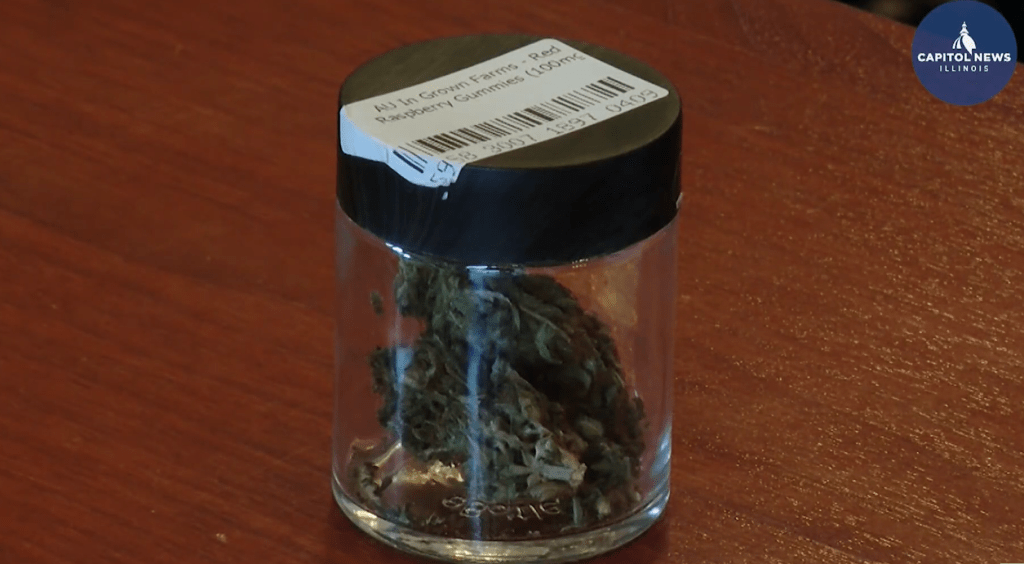
Transcript of Hearing
Full transcript of House Committee Hearing on SB42
Chairperson Justin Slaughter: The chair recognizes leader Tarver to present Senate Bill 42
Representative Curtis J. Tarver, II: Thank you Mr. Chair and members of the committee. Let me just start with the end in mind. My goal, in the most ideal situation, is to move this to second, to hold it on second, and to continue to work with my colleagues and law enforcement more specifically, toward a path.
This bill is the result of many things — not the least of which are two court cases from the Illinois Supreme Court. And I’m going to read this to quote kind of what the issue is here. It’s talking about burnt cannabis being transported in a vehicle versus raw cannabis being transported in a vehicle.
One of the things that [the Supreme Court] suggested was that the legislature should consider amending the Regulation Act, as well as a Vehicle Code, as both statutes govern how an individual may possess cannabis within a motor vehicle on Illinois highway. Because both the Vehicle Code and the Regulation Act regulate the possession of cannabis in a motor vehicle on the highway, consistency between the two laws is essential — so the users of cannabis know how to possess cannabis without violating laws, and so police officers know when they have the probable cause to enforce laws.
So right now the question is really more about, warrantless searches and probable cause.
I will again say this bill is not the solution. I think that’s very clear from talking to members of this committee, also talking with law enforcement. But I just seek the opportunity to continue to work on the issue.
Happy to answer any questions.
Chairperson Justin Slaughter: Thank you. Leader Tarver, we’re actually going to open the roll before we proceed here.
Rep. Vice Chair Cassidy moves that Senate Bill 42 do pass. Can we open the roll?
All right, we’re getting back to some witness slips, Leader.
538 proponents, 2,844 opponents. 20 have filed on a no position.
Questions on Senate Bill 42? Leader Windhorst.
Republican Spokesperson Patrick Windhorst: Thank you, Mr. Chairman. First, as to the agreement to hold on second — do I understand that correct? There is an agreement to hold on second?
Representative Curtis J. Tarver, II: That is correct. I’ve spoken with, I believe, yourself, folks on my side, as well as law enforcement you see behind me. With that commitment — that is correct.
Republican Spokesperson Patrick Windhorst: And just to be clear for the record, what does—what is that agreement? Will there have to be a consensus among the stakeholders for it to move? Or—I just want to make sure I understand what the commitment is on the hold.
Representative Curtis J. Tarver, II: It’s a fair question. I have never made it a practice to say that I’ll get absolutely everybody on board, because then that kind of ties my hand. But I’ve always been somebody who works in good faith.
I don’t anticipate a scenario in which all of law enforcement remains opposed, members of my side remain opposed, you remain opposed, and the bill still moves.
So that’s a long winded way of saying: I commit to working diligently and in good faith with all the stakeholders — your side, my side, law enforcement (who I consider to not be either side) — to try to put something forth that makes sense.
Republican Spokesperson Patrick Windhorst: I know we’ve already had a long time this morning and I don’t want to take up too much time, but there is a concern I have as it relates—ever since we’ve legalized cannabis for recreational use—around intoxicated motorists.
We have seen, according to a Chicago Tribune article from 2023, after legalization, an increase in fatal crashes. The rate of fatal crash drivers who tested positive for marijuana rose from 25% in the two years before legalization to 37% in 2020, the first year of legalization.
And there have been other studies and information that shows there has been an increase in intoxicated motorists under the influence of cannabis.
The issue we have, number one, is there have been some—there are some potential problems in our current DUI statute as it relates to cannabis. And the changes in that statute that occurred prior to legalization—with legalization—have created some gaps that have been identified by law enforcement and prosecutors. Even defense attorneys have identified these issues.
Added to that is the lack of a standard, and also roadside testing similar to a breathalyzer.
So the issue I have with changing the provisions related to the smell or the odor of raw cannabis is that we’re going to make this issue that has been identified as an issue even worse. And my preference would be to resolve those intoxicated motorist issues before we start making changes to the cannabis statute in your direction.
So I’ve actually said a lot—not really, perhaps, asked a question. I’ll just allow you to respond to that if you’d like.
Representative Curtis J. Tarver, II: I’ll say this. I don’t think any of us disagree about a collective desire to reduce fatalities in general, no matter how somebody’s intoxicated or otherwise. So I will share that with you.
I don’t know the nuances of the gaps that you identify, but I’m happy to have that conversation.
What I will say is that the underlying thing for a lot of these bills—your community and my community may be different, right? And so, some of the concerns of folks in my community is how broad some of these things are, and everybody may not be policed the same, right? That’s not an indictment on Tipsword, Cabello, or Sheehan, or whatever, right? It’s just the reality that it’s human, right?
And so my goal is ultimately to work towards something that makes sense—not something that ties the hands of law enforcement, right? Not something that also allows something that is wide enough, again, that people say drive a truck through—something that makes sense.
I mean, the Supreme Court clearly is, I think to some extent, asking us to do something, because they’re interpreting, you know, burnt versus raw [cannabis], coming up with two different opinions, and then saying that we probably need to amend the vehicle code.
So if your position is, “Hey, look, why don’t we look at things holistically?”—I’m never going to say no to that, right?
Can I say that the bill that comes back that we work on related to cannabis is going to include things related to alcohol? I cannot say that for sure. What I can say is, if you have a concern in that regard, I’m happy to talk to you about that and work toward whatever is going to keep people safe. I don’t care what they look like at all. I want to keep people safe the same way that you do. How we arrived there may be different, but it’s a conversation, I think, that’s worth having.
Republican Spokesperson Patrick Windhorst: And just briefly, Mr. Chairman, the issue isn’t so much around alcohol intoxication. The law, I think, is pretty well developed there. It’s the fact that after legalization, the law, really as it relates to cannabis-intoxicated motorists, has not been developed, and is causing gaps and creating large issues with enforcement—which has resulted in increased fatal accidents. At least, I believe you can draw a line that connects those.
So I do appreciate your openness to being willing to potentially address that issue as well. And, you know, the Supreme Court, with its decisions, has created a distinction between raw cannabis and burnt cannabis.
You know, I would probably go a different direction than you. I think the odor of burnt cannabis suggests maybe there is an intoxicated driver, and that should be the cause for a continued detention or stop at the time and potential search.
But, I appreciate your answer, and I think this is an issue on the motorist aspect that we really need to address to make sure our roads are safe.
Chairperson Justin Slaughter: All right. Thank you, Leader Windhorst. We’re going to go to Rep. Morgan…Rep. Morgan, the floor is yours.
Representative Bob Morgan: Thank you, Chair. And for the sake of time, I’ll be very, very brief.
Leader Tarver, thank you for continuing to work on this. I’ll be a yes today to move it out of committee to continue to work with you, and thank you for hearing my concerns and the concerns of this committee—both Democrat and Republican alike, and law enforcement advocates.
I do want to say, Leader Windhorst’s questions—talking about determining those who are intoxicated and driving—that’s a very complicated issue, which really is related but different and distinct from what you are trying to do here.
The Illinois Supreme Court had two different rulings, as a reminder—one dealing with burnt cannabis [and] one dealing with raw [cannabis]—which is why we’re here. I think Leader Tarver is committed to continuing to work on a solution to address those two rulings. But those rulings really did have to do with probable cause, as opposed to intoxication and impairment.
The intoxication and impairment issue—dealing with cannabis impairment—is a national issue. It’s a scientific issue, one that we have not resolved as a country. And I don’t think we should have an expectation that Leader Tarver will solve that in the next coming weeks or years, because it’s complicated. And so I do want to distinguish that—and expectations.
So again, this is something that has been a challenge for many, many years. Many of our law enforcement partners that are here have been working with me, with Representative Cassidy, with others on this issue for many years, and it is very complicated.
But I think it’s indisputable that Black and Brown drivers are dealing with this on a daily basis in a way that White drivers are not. So I don’t think we should lose sense of why we’re here and the importance of getting this right.
Because we can talk about the ability for law enforcement to do what they’re doing and do what they have to do to make sure we’re not having drug trafficking across state lines—which is a priority of mine—as well as the fact that the standard we have today is creating disproportionate impact on drivers.
So thank you, Leader Tarver, and I’m going to keep working with you, and we’re gonna get this done.
Chairperson Justin Slaughter: Thank you Representative Morgan. Representative Tipsword?
Representative Dennis Tipsword: Thank you, Mr. Chairman.
I’ve got several questions, and they may not quite be in order—just some ideas. I know we’ve heard some answers to some of the questions I had.
The way we’re striking odor out of this legislation is going to make it virtually impossible to enforce other aspects of the legislation. And the example I have is—we’ve stricken odor, and we can’t search a vehicle based on odor alone, but we still have the provision that it has to be in a child-restraint container.
Well, I can’t tell by the smell if it’s in a child-restraint container or…child-resistant container, I’m sorry. And I’m just worried about—you know, we always talk about children who end up finding drugs and things like that, and those unintended consequences to kids. You know, these two pieces kind of went together. So we could search a vehicle based on the odor and find the other underlying problems that may be going on in that.
So I guess that would be my first question: How do we handle, you know, keeping our kids safe when drugs may be in the car that kids can easily get into?
Representative Curtis J. Tarver, II: I heard a lot there. I’m not sure I understand the specific question.
So if we remove what specifically? Let me look at the bill.
Representative Dennis Tipsword: Well, if we can’t search the vehicle based on the smell of odor—so we smell cannabis in a vehicle, and let’s say it’s a mom or a dad with two or three young kids in the car—and we smell cannabis. Raw cannabis, not burnt cannabis—two distinct smells.
And I can’t search the car now based on odor alone, but there’s a possibility those young kids could find that cannabis in the car. And maybe it’s—and if I can smell it, it’s probably not in a child-resistant container.
Representative Curtis J. Tarver, II: Yeah, I would probably agree to disagree on the whole whether or not it’s in a child, uh, container that is restrained. But I think the notion that because you can’t—you don’t have probable cause solely based on raw cannabis—somehow means you have potentially no probable cause, that coupled with other things is where we’re probably differing.
If the notion that it’s raw cannabis [or] they’re probably intoxicated, or whatever else—the eyes are going to be blood-shot. I mean, there are going to be things that I think will—I’m not law enforcement—but they may typify someone who has been…
Representative Dennis Tipsword: I’m not talking about um being under the influence right now
Representative Curtis J. Tarver, II: So, your concern is that that a child may be able to get to the cannabis?
Representative Dennis Tipsword: Yes. And that’s all…and look: we’re really getting in deep here but, that’s an issue. Alright. Let me move on to another question I have. And I know you know these things, but I just want to point out to everyone in the committee who may not know: I, as a trained police officer, can’t tell the difference in the smell of raw cannabis on an amount—whether it’s 1 ounce or 100 pounds. There’s no difference in the smell.
Our trained canines can’t tell the difference either. They just alert to an amount.
So your unintended consequence here is going to open up the door to drug trafficking immensely. Because all a person would have to do is have a small bag of marijuana with them—and 100 pounds in the trunk.
So that’s why—look, I understand there’s a difference between burnt and raw, and we can have that discussion. But when you’re talking about raw, we’re not—in my mind, I’m talking about trafficking. That’s what worries me.
So I’m curious, in your mind, how we continue to try to get the traffickers off the street and still live in the letter of what you have here.
Representative Curtis J. Tarver, II: It’s a great question. I think this is what will provide the seminal basis of our disagreement.
What you’re saying my bill does—is that it broadens the scope for traffickers—what the law does right now is leave it very, very wide open for particularly Black and Brown people to be discriminated against when they’re pulled over. Because the issue that we’re having is everybody’s not being policed the same.
So I hear you about the traffickers, because I don’t want traffickers either. But I also want to be able to drive down the street and have the same respect and dignity and treatment overall as everybody else—and that’s what’s not happening.
So I think that’s the reason why you see a difference with positions on this bill. It’s because what you’re saying makes sense—nobody wants to tie the hands of law enforcement as it relates to traffickers. I also want to be able to drive through Orland Park and feel just the same way I do in Gage Park or Washington Park or any other park. And that’s an issue.
And I haven’t heard anything to control for that and to solve that issue. And that’s a very important issue in my community.
Representative Dennis Tipsword: I understand that, and I think I’m going to push back a little bit on that statement.
I think—maybe that’s relative to the community you live in. Where you live, majority of the folks are Black and Brown folks. Where I live, they’re not.
So the traffic stops in my area…
Representative Curtis J. Tarver, II: That’s an assumption that you’ve made. You don’t know where I live, but go ahead.
Representative Dennis Tipsword: You know, I think some of that is relative, though. So I—look, I appreciate what you’re trying to do there.
So here’s another concern I have. It says in here that if there is a person in the vehicle 21 years of age or older—so all that takes is one person, and they don’t have to be the driver. They can be the occupant.
And I could have three 16-year-olds in the car, but I can’t search the vehicle if there’s one person over 21 years of age, because potentially they’re old enough to buy recreational marijuana.
Again, we are, I think, turning a blind eye to kids who could still be in possession and using drugs based on this one loophole of having a 21-year-old in the car.
Representative Curtis J. Tarver, II: So let me push back a little bit on that, because what I said at the beginning was: the Supreme Court said you all should probably consider fixing it.
I also said right behind that—this doesn’t fix it.
So I get your questions, and I appreciate them, but I didn’t say this paragraph—this is the end all be all, this solves it. What I said was I would like to commit to continue to have conversations—whether it be with you individually, you all collectively, my side of the aisle, these gentlemen next to me—I’m open to having a conversation.
So if you tell me, “Hey look, this is creating a loophole and it can potentially be harmful for children,” there’s no way I’m going to say on the record or even in private, “Too bad.” Okay, let’s figure it out.
So I hear you. I appreciate you expressing the concerns. But my response is going to typically be—except as it relates to how people are policed maybe differently—the other things, sure, let’s have a conversation.
If that is a concern of yours—if you see me when Windhorst is talking—I’m doing this, I’m jotting down notes.
Representative Dennis Tipsword: I appreciate that, but you’re trying to have the conversation on the back end now. Not once have you come to me and asked my professional opinion on law enforcement.
I don’t know that you have any of the other members—maybe you have. But here we sit in committee, on the final hours of deadline day, 45 minutes behind, waiting to try to get this bill to the table. We’ve subbed members out of the majority party.
This bill is not ready. I’m very happy to have a discussion with you.
Representative Curtis J. Tarver, II: Okay. So, stating the obvious—the bill is not ready. I started off with that. I can’t control when a bill is called in committee. I think you know that as well.
Okay? I’ve also voted for bills for Republicans. I’ve moved bills out of Revenue Committee for Republicans. Ask Amy Elik—she moved one yesterday. Okay?
So whether people sub off—all the stuff you’re talking about—I help both sides. When there’s something that is reasonable, I help both sides. When there’s something that still needs work, I help both sides.
I did not come down here and run a bill down your throat. I’ll have a conversation with anybody. And it’s not on the back end. I have had conversations.
When you came to me yesterday, I said, “I’m not sure when the bill is going to be called.” That’s what I said. I came in here this morning. I talked to Kaitschuk. I talked to this gentleman. I’ve not run from the fact that this is a bill that needs some work.
And I will have any conversation. But I take great offense to the notion that I’m somehow sandbagging or wouldn’t talk to you. I talk to every single person. I’m on your side of the aisle every single day—every single day—I come over and speak to folks about something that’s not related to this bill.
So I take offense to that.
Chairperson Justin Slaughter: And members, we certainly appreciate the robust conversation. If we could bring it back to the actual merits of the bill and discussing provisions that are in the bill.
Rep. Tipsword had a few points—are you—do you still have another question?
Representative Dennis Tipsword: [Yes]
Chairperson Justin Slaughter: Okay, please proceed.
Representative Dennis Tipsword: I guess the last question—so you made the commitment to hold on second. Is that going to be to bring it back to committee so we can discuss that here and really vet it more, or is this going to be a bring-it-back-straight-to-the-floor?
Representative Curtis J. Tarver, II: What would you prefer? I’ll make that commitment?
Chairperson Justin Slaughter: Leader Tarver and I have talked about this. He’s committing—if he is blessed to get it on second—he’s committing to bring it back with an amendment.
Representative Dennis Tipsword: I’m sorry…he committed to bring it back to the committee, is that what you said chair?
Representative Curtis J. Tarver, II: For the record, I think I stated this—but yes, I’m willing to bring it back to the committee to have the public conversation about the bill.
Representative Dennis Tipsword: Thank you. If I missed committee, I apologize. I heard you say you were going to hold it on the second, but I just wanted to get that on the record.
That’s all I have, Leader. Thank you, Mr. Chair.
Chairperson Justin Slaughter: Leader Cabello
Representative John M. Cabello: I appreciate that you’re going to be bringing this back. I’m willing to help talk with you through some of my issues.
I know we’re in the interest of time, but I do want to bring up the fact that if there’s issues with people being pulled over in your district that you think there are issues—we need to work on that issue, and I’ll work on that issue with you together. You have my commitment on that.
Unfortunately, I’m going to be a no today. But I do want to talk to you about it, and if we can come to some sort of agreement and we can make the bill palatable, I’ll be with you.
Representative Curtis J. Tarver, II: I appreciate you always being incredibly candid and forthright. Thank you.
Chairperson Justin Slaughter: All right. Look, little bit of a time issue. I do see that there’s members from law enforcement that have approached the table. I’m assuming you have some testimony—can you make it very brief?
Jim Kaitschuk: Always, Mr. Chairman. Jim Kaitschuk with the Sheriff’s Association.
I think, honestly—quite honestly—a number of the issues that we had raised with Representative Tarver and with yourself, Mr. Chairman, have already been discussed, so I’m not going to belabor those points.
Certainly, Leader Tarver and I have had a number of conversations about this. We will continue to do so. Obviously, our concerns are well known here.
One of the biggest things, obviously, is impacting the trafficking. And I understand Leader Tarver has no desire to do anything that would enhance that ability of traffickers coming into the state, for a variety of reasons, of course.
But we certainly stand ready to talk to him.
I don’t know—I can’t tell you that I think there’s a solution, you know, that would trade off odorless containers. So I don’t want to be disingenuous about that.
I do have the same concerns that were mentioned in terms of not being able to search a vehicle for those under 21, because those under 21—it’s zero tolerance. So they’re not allowed, legally, to have cannabis in this state. With that said, I’ll stop.
Chairperson Justin Slaughter: All right. Thank you, Mr. Kaitschuk.
Listen, thanks for the robust discussion, everyone. The roll is open.
Mr. Clerk, can continue with that roll. Leader Tarver, thanks for bringing this forward. You know, we know that we’ve gotten two opinions from the Supreme Court on this. It is an area that I believe we need to continue to work on. I’m a yes.
Clerk: Cassidy?
Representative Kelly Cassidy: Thank you for your commitment to keep working on this. Tag me in, I’m happy to help, I’m a yes.
Clerk: Windhorst?
Republican Spokesperson Patrick Windhorst: No.
Clerk: Cabello?
Representative John M. Cabello: No.
Clerk: González?
Representative Edgar González, Jr.: Yes.
Clerk: Guerrero-Cuellar?
Representative Angelica Guerrero-Cuellar: No.
Clerk: Morgan?
Representative Bob Morgan: Yes
Clerk: Ryan?
Representative Rick Ryan: No.
Clerk: Sheehan?
Representative Patrick Sheehan: No
Clerk: Tipsword?
Representative Dennis Tipsword: No.
Clerk: Andrade?
Representative Jaime Andrade: Yes.
Clerk: Tarver?
Representative Curtis J. Tarver, II: Yes.
Clerk: Mah?
Representative Theresa Mah: Yes.
Clerk: 8 in favor, 6 opposed.
Chairperson Justin Slaughter: With eight votes in favor, six votes opposed, zero voting present Senate Bill 42 is declared passed before we report it to the House floor. Thank you Leader Tarver.
Comment below with your thoughts and consider supporting my work!
You can support The Cole Memo with a one-time, monthly, or yearly contribution.
Support The Cole Memo by making a one-time contribution
Support The Cole Memo with monthly contributions
Support The Cole Memo with yearly contributions
Choose an amount
Or enter a custom amount
Your contribution is appreciated. Your contribution helps us afford equipment to capture our content and hosting fees to distribute our content.
Your contribution is appreciated. Your contribution helps us afford equipment to capture our content and hosting fees to distribute our content.
Your contribution is appreciated. Your contribution helps us afford equipment to capture our content and hosting fees to distribute our content.
DonateDonate monthlyDonate yearly
#265 – Arrested during Michigan Weed Run, Illinois Lawsuits, and a Market Shakeup – The Cole Memo
- #265 – Arrested during Michigan Weed Run, Illinois Lawsuits, and a Market Shakeup
- #264 – Cannabis, Congress, and Competition: A Conversation with Stacy McCaskill
- #263 – Talking Movies, Cannabis, and Content Creation with Byron from LostNFaded
- #262 – Odor-Proof Packaging, Witness Slips, and Illinois Cannabis Regulator Vaughn Bentley’s Take
- #261 – Recapping Governor Pritzker’s Address with Jeremy Gorner
 The Cole Memo
Leave a comment