
Illinois cannabis policy has made little headway over the last decade. Only a small number of proposed changes have successfully become law. This article explores what the future may hold for cannabis consumers and entrepreneurs in Illinois in 2025. The end of the article highlights key cannabis policy developments over the years.
2025: The Year for Cannabis Policy Change in Illinois?
As the Lame Duck legislative session in Springfield approaches—a brief period that lasts from January 2nd to January 7th—industry stakeholders are intensifying efforts to advance policy amendments in HB2911, aimed at updating the Illinois Cannabis Regulation and Tax Act of 2019 (CRTA).
In addition to proposed amendments to the CRTA, Governor Pritzker recently expressed support for a bill (HB4293) that would effectively criminalize the sale of federally-legal hemp. The bill introduces $10,000 daily fines and criminal penalties which would exclusively target in-state retailers selling hemp-derived legal THC (HDLT) products and CBD.
HDLTs and CBD products are readily available in liquor stores (like Binny’s), online retailers, and other traditional retail channels, much like any other (legal) consumer packaged good. CBD products have become popular among pet owners and arthritis sufferers seeking the therapeutic benefits of cannabis without the buzz.
In case you didn’t know: products regulated under the CRTA remain federally illegal and are classified as Schedule I substances under the Controlled Substances Act.
Legal professionals have argued that “hemp” is essentially descheduled cannabis. For context, alcohol and tobacco are also descheduled substances.
Critics contend that HB4293 would effectively ban all federally-legal cannabis products, such as HDLTs, from being sold outside of the small and tightly controlled number of dispensaries in Illinois.
In response, Representative Sonya Harper introduced HB5903, a bill aimed at addressing valid concerns raised during the contentious debate over federally legal cannabis products. The legislation would allow Illinois to regulate hemp products through mandatory testing, truth-in-labeling requirements, and age restrictions, while steering clear of measures that unfairly target local businesses or criminalize these products.
What Is the Lame Duck Session, and Why Does It Matter?
The Lame Duck session refers to the final days of a legislative assembly’s term, often seen as a last-ditch opportunity to pass bills before new legislators take office. For Illinois’ 103rd General Assembly, this means any unresolved legislation that hasn’t reached the Governor’s desk by the session’s end will effectively die when the assembly adjourns sine die, or “without a day” for reconvening.
In other words, the conclusion of the Lame Duck session resets the slate, requiring new bills to be reintroduced in the next assembly.
Potential Cannabis Policy Changes
To explore the topics I’ve detailed below, simply click to expand.
The Movement to Ban In-State Retailers from Selling Federally-Legal Cannabis
House Bill 4293 initially focused on regulating massage therapists. The original language on massage therapy was removed and replaced with provisions targeting federally-legal cannabis products.
As mentioned earlier, this proposal would significantly increase penalties for the cultivation, processing, and sale of cannabis flower, concentrates, and infused products in Illinois by adding $10,000 daily fines on top of the criminal penalties that have existed in Illinois since 1978.
Governor Pritzker has expressed concern that these products are “often shipped from out of state and lack oversight or testing for biological contaminants or pesticides.”
Senator Kimberly Lightford, the lead sponsor of the bill, clarified during an exchange with Senator Willie Preston that HB4293 would not affect online sales. In other words, the bill exclusively targets local Illinois businesses while allowing out-of-state retailers to continue serving Illinois consumers.
Senator Willie Preston: “Are there any provisions in this legislation that will prevent the purchase of these products from online companies outside of the state of Illinois?”
Senator Kimberly Lightford: “Right, we’re unable to regulate outside of the state of Illinois, so we have no regulations.”
When public stakeholders were given the opportunity to respond to HB4293, nearly 96% expressed opposition, according to public records. The overwhelming opposition reflected in the witness slips highlighted the disconnect between the bill’s swift progression through the legislative process and the concerns of consumers and industry stakeholders. Opponents criticized the timing and the lack of transparency, pointing out that the rushed timeline left little room for meaningful input or debate.
To address the small number of valid concerns that were raised during the rushed and contentious debate over HB4293, Illinois Representative Sonya Harper introduced HB5903.
HB5903 would effectively regulate federally legal hemp products without targeting local Illinois businesses. HB5903 includes mandatory testing, truth-in-labeling requirements, and age restrictions to ensure that only individuals aged 21 and over can purchase these products, while rejecting protectionist measures that would unfairly criminalize a federally legal product.
Moreover, the bill specifies that any hemp products distributed or sold in violation of its provisions would be deemed adulterated or misbranded under the Illinois Food, Drug, and Cosmetic Act and other applicable state laws. In essence, HB5903 strikes a balance between consumer protection and the principles of open commerce that define free enterprise in this country.
“[Hemp] harms not only the cannabis industry but, most importantly, it’s poisoning the people in the state of Illinois.”
Erin Johnson, Cannabis Regulation Oversight Officer in Illinois
Dispensaries in Illinois remain largely inaccessible. Delivery services are prohibited, despite Governor Pritzker previously expressing support for the idea. Credit cards are not accepted, the number of dispensaries is extremely limited, and Illinois has some of the highest cannabis prices in the nation.
As a result, critics and cannabis consumers argue that HB4293 is a major step backward that threatens the accessibility that cannabis consumers have enjoyed with these federally-legal cannabis products.
As mentioned at the beginning of this article, the Illinois cannabis market is now over a decade old. For many cannabis consumers, the accessibility provided by these federally-legal hemp products has been a refreshing alternative in a state known for its restrictive and overpriced market.
I recently wrote a policy paper outlining a path forward for hemp, marijuana, and cannabis. Since its release, two cannabis regulators have personally reached out to share that they found value in my proposal—one of whom currently serves in the state of Illinois. The proposal that (mostly) aligns with the standards outlined in my policy paper is HB5903.
If you’d like to learn more about HB5903, we discussed the legislation on episode 141 of the Cole Memo Podcast. To hear hemp growers respond to and fact-check Governor Pritzker’s recent press conference on HB4293, click here.
The Push to Amend the CRTA via HB2911
In January of 2024, groups like the Cannabis Equity IL Coalition, Chicago NORML, and others unveiled their legislative priorities for cannabis policy in Illinois.
These priorities include revising and advancing items from the previous cannabis omnibus bill, SB1599. If enacted, they could also provide enhanced support for medical patients.
Several of the priorities outlined by these groups have been incorporated into the new cannabis omnibus bill, HB2911. Some of these provisions have sparked controversy, while others simply didn’t make the cut—such as a proposal to increase the plant count for medical cannabis patients.
Proposals That Didn’t Make the Cut
HB2911 addresses several priorities for the industry, but not every proposal has made it through or into the legislative process. Some measures that were aimed at advancing meaningful reform in Illinois cannabis policy were left on the sidelines.
Tight legislative deadlines, competing interests, and political hurdles often result in important initiatives being sidelined. With that said, there seems to be renewed optimism that at least one of these ideas could be revisited in the near future.
Below are some of the proposals that didn’t make the final cut.
Home Cultivation Expansion Fails to Make the Cut
The proposed expansion of home cultivation rights for registered medical patients was intended to address the practical needs of those who rely on cannabis for continuous treatment. This is especially true for patients who create edibles or infused products, as these often require more raw cannabis than the current five-plant limit permits. Increasing the plant count would have ensured that Illinois medical cannabis patients had sufficient access to the cannabis they need for their treatment without the fear of criminal penalties.
Currently, patients cultivating more than the allowed number of plants risk facing criminal charges. The primary objective of this proposal seemed to be aligning the legal framework with the practical realities of medical cannabis use. By doing so, it sought to allow patients to adequately and legally meet their medical needs, reducing the risk of unnecessary legal complications. Despite its potential benefits, this idea did not make it into any legislation.
Illinois Police Block Efforts to Remove Odor-Proof Container Requirement
In a move that has largely gone unreported, the Illinois Sheriff’s Association (ISA) opposed a provision aimed at removing the odor-proof container requirement for cannabis. As a direct result, language that could have resolved the criminalization of innocent cannabis possession was removed from HB2911.
This occurred prior to the Illinois Supreme Court’s ruling, which upheld the constitutionality of the odor-proof container mandate. The responsibility for addressing this issue now falls to the General Assembly. If lawmakers continue to yield to law enforcement preferences, cannabis consumers across Illinois will continue to face rights violations and criminal penalties.
The Illinois State Police (ISP) has indicated that they plan to resume training dogs to detect the smell of cannabis. This could be used to justify vehicle searches based on odor alone, raising concerns about the ongoing criminalization of cannabis users.
This issue illustrates the need for legislative action that prioritizes the rights and protections of cannabis consumers in the state. From what I can gather, there is currently no momentum or coordinated effort within the General Assembly or among advocates to address this issue.
Cultivator Allegedly Blocks Tax Relief for Medical Patients
According to the Illinois Cannabis Equity Coalition (CEIC), Green Thumb Industries (GTI), a licensed cannabis operator, opposed the bill due to provisions related to medical cannabis patients. Ultimately, language that would have allowed registered medical patients to access any licensed dispensary as medical patients was removed from HB2911. In response, CEIC called for a boycott of GTI.
Green Thumb Industries has denied these allegations.
Advocates acknowledged the removal of this language was problematic but ultimately agreed to advance HB2911 in its current form in an attempt to ensure that other policies could still cross the finish line. Insiders originally informed me that pushing for legislators to reintroduce this language could jeopardize the chances of passing any legislation, as it would require the bill to go back through the Senate and then the House before reaching the Governor’s desk.
With all of that said, I’ve recently learned from advocates that there are renewed hopes of reintroducing and passing this language during the upcoming Lame Duck session. The state’s Cannabis Regulation Oversight Officer, Erin Johnson, recently echoed this sentiment in a quote that was featured the Daily Herald.
“Working on medical patients is absolutely one of the things we’re committed to. We hope that legislation will move in lame duck session, but if not, we’ll move it again in the spring.”
Below are some of the proposals that I have been told still have a chance.
Proposals From HB2911 That Are Still in Play
Based on what I can gather from conversations I have had with advocates and reporting by the Chicago Tribune, HB2911 includes provisions that would:
- Allow curbside pickup and drive through at dispensaries for medical and adult-use cannabis
- Based on information from multiple sources, it seems this provision may codify priority curbside pickup for medical cannabis patients, though I have not been able to independently confirm this.
- Increase Canopy Space for Craft Growers to 14,000 Square Feet
- Standardization/Streamlining of Online Application & Badging Process for Prospective Works
- Allow for Remote Evaluations for Medical Cannabis Patients
- This was originally allowed in 2020.
Advocates recently shared with me that they see a path forward to amend HB2911, adding a provision that would allow medical patients to shop at all dispensaries.
Advocates have also shared additional items are included in HB4293. For reference, I’ve attached a one-pager provided by the Cannabis Equity Coalition of Illinois outlining their perspective on HB4293.
Highlights of Cannabis Policy Changes Over the Years
Below is an abbreviated recap of some of the cannabis policy progress that Illinois has made over the years. Click to expand the topic for more details.
Cannabis Policy Highlights in Illinois
- In August 2013, Governor Patrick Quinn signed into law the state’s medical marijuana program. The law was set to last for 4 years and was referred to as a “pilot program”.
- According to the Chicago Tribune, drafters of Illinois’ law considered it among the toughest in the nation. The legislation prohibited home cultivation, required patients to have an established relationship with a prescribing doctor, and limited eligibility to those with serious or chronic conditions such as cancer, multiple sclerosis, glaucoma, or HIV.
- The law originally required that the Secretary of State added a notation to a registered patient or designated caregiver’s driving record.
- This allowed law enforcement officers to instantly identify whether the driver was a medical cannabis cardholder or a designated caregiver when scanning a license plate.
- Critics argued that this practice violated patient privacy and led to preemptive law enforcement stops based solely on an individual’s cardholder status.
- This allowed law enforcement officers to instantly identify whether the driver was a medical cannabis cardholder or a designated caregiver when scanning a license plate.
- The law required medical cannabis patients to undergo background checks and fingerprinting, which they had to submit to the state of Illinois before receiving final approval to legally purchase and possess limited amounts of cannabis.
- The law created a small & limited number of cultivation centers and dispensaries.
- According to the Chicago Tribune, the measure originally banned licensed growers and dispensaries from donating to political campaigns.
- In May of 2019, Governor Bruce Rauner signed a bill into law which would extend the medical cannabis pilot program to July of 2020 and added post-traumatic stress disorder and terminal illness as qualifying conditions.
- A compromise was made to put the medical advisory board more directly under the governor’s control, giving the state Department of Public Health director more input over whether to approve any new conditions.
- Under Bruce Rauner’s leadership, the director of IDPH rejected every new condition proposed by the advisory board.
- A compromise was made to put the medical advisory board more directly under the governor’s control, giving the state Department of Public Health director more input over whether to approve any new conditions.
- In August of 2016, Governor Bruce Rauner signed a bill into law which decriminalized small amounts of cannabis.
- Under the new law, possession of 10 grams of marijuana or less is punishable by fines ranging from $100 to $200, rather than jail time. Previously, Illinois law classified possession of up to 10 grams as a Class B misdemeanor, carrying penalties of up to six months in jail and fines of up to $1,500.
- Created a per-se limit for cannabis.
- A lawmaker revealed that they “literally made up” the per-se limit for cannabis in Illinois.
- Legal professionals and scientific researchers have argued that there are fundamental flaws in the methodology that is practiced by one of the only labs in the state of Illinois that performs this type of testing in response to the change in the DUI statute
- Note: Months after I exposed the flawed methodology used by one of our state labs, ABC7 and other outlets began reporting similar concerns.
- Legal professionals and scientific researchers have argued that there are fundamental flaws in the methodology that is practiced by one of the only labs in the state of Illinois that performs this type of testing in response to the change in the DUI statute
- Some lawyers have argued that this law provides immunity to medical cannabis patients. I have not been able to independently confirm that.
- A lawmaker revealed that they “literally made up” the per-se limit for cannabis in Illinois.
- In 2018, a bill was signed into law that allows caregivers of minor registered patients to administer medical cannabis on school property.
- In 2019, Governor J.B. Pritzker signed House Bill 2023 into law, expanding Illinois’ medical cannabis program. The bill:
- Made the Medical Cannabis Pilot Program (MCPP) and OAPP permanent, ensuring long-term access for patients.
- Removed the word “tamper-evident” from the cannabis container language
- Some law enforcement officers were causing issues for cannabis consumers over “broken seals” on cannabis packaging. This change clarified that cannabis is no longer treated as a “one-way” product. In other words, as long as your cannabis was in a sealed, child-proof, and odor-proof container you should be in compliance with the law.
- Required the Department of Financial and Professional Regulation to adopt rules allowing returns and potential refunds for damaged or inadequate products.
- Established the Opioid Alternative Pilot Program (OAPP) to provide an alternative treatment path for chronic pain patients.
- Allowed provisional access to dispensaries for medical cannabis patient applicants.
- Removed fingerprinting requirements and eliminated disqualifying criminal offenses for applicants.
- Prohibited organizations from charging fees to assist patients with medical cannabis applications.
- Allowed veterans receiving medical services at VA facilities to participate in the OAPP.
- Expanded the list of healthcare professionals who can certify medical cannabis use to include Physician Assistants (PAs), Advanced Practice Nurses (APNs), and Nurse Practitioners (NPs).
- Added new qualifying conditions, including autism, chronic pain, irritable bowel syndrome, migraines, osteoarthritis, anorexia nervosa, Ehlers-Danlos Syndrome, Neuro-Bechet’s Autoimmune Disease, neuropathy, polycystic kidney disease, superior canal dehiscence syndrome, and expanded Crohn’s disease to include ulcerative colitis.
- Allowed patients to designate up to three caregivers, providing greater flexibility for both adult and minor patients.
- Required immediate dispensary changes for MCPP patients.
- Previously, patients were limited to shopping at a single dispensary, and switching dispensaries involved a lengthy process that could take over a week to complete.
- With this change, patients were still required to register with a dispensary, but the process became electronic, significantly reducing the time needed for completion.
- In 2019, Governor Pritzker signed SB0455 into law. The law allowed a nurse or school administrator to administer medical cannabis products and allows students to self-administer under the direct supervision of a school nurse or school administrator.
- In June of 2019, Governor Pritzker signed HB1438 into law. The bill:
- Allowed registered medical cannabis patients to grow up to five cannabis plants for personal use.
- Decriminalized the possession of small amounts of cannabis for all adults.
- Established a new offense for the improper possession of cannabis. If cannabis is not stored in a sealed, child-proof, and odor-proof container, it is considered a Class A misdemeanor, punishable by fines and up to one year in prison.
- Reminder: Between 2016 and 2019, possessing cannabis in a motor vehicle was only a citable offense. HB1438 created new criminal penalties for simple possession of cannabis in Illinois.
- Legal professionals on The Cole Memo Podcast have argued that this language was influenced by law enforcement, who benefit from using it to bypass Fourth Amendment protections and search the vehicles of cannabis users.
- Reminder: Between 2016 and 2019, possessing cannabis in a motor vehicle was only a citable offense. HB1438 created new criminal penalties for simple possession of cannabis in Illinois.
- Permitted adults aged 21 and older to purchase small amounts of cannabis from a limited and tightly controlled number of dispensaries.
- Did not repeal any of the criminal penalties established under the Cannabis Control Act of 1978.
- In December of 2019, Governor Pritzker signed SB1557 into law. The bill:
- Required the Secretary of State to remove all notations from driving records indicating that a person is a registered medical cannabis patient or caregiver within six months of the bill’s effective date.
- Allowed local governments, including both home rule and non-home rule counties (in unincorporated areas), to permit on-premises cannabis consumption at dispensaries or retail tobacco stores within their jurisdiction, as long as it complies with state law.
- Provided that cannabis and cannabis-derived products regulated under the Industrial Hemp Act are not subject to the rules of this Act.
- In August of 2021, Governor Pritzker signed HB1443 into law. CROO released this fact sheet on HB1443. The bill:
- Redefined “cannabis container” to include the term “resealable,” strengthening the language to protect consumers from law enforcement actions targeting individuals for “breaking the seal” on their cannabis containers.
- Eliminated the requirement for medical patients to register with a specific dispensary, allowing them to purchase from any medical dispensary in Illinois without needing to update their registration through the state’s online system.
- In December of 2023, Governor Pritzker signed SB1559 / HB3817 into law. The bill:
- Decoupled Illinois from Federal Tax Code Section 280E. This allowed state-licensed cannabis businesses in Illinois to deduct ordinary business expenses on their state taxes, even though these deductions are not allowed under federal law.
- Mandated the transfer of $40 million from the Compassionate Use of Medical Cannabis Fund to the Cannabis Business Development Fund. This transfer was made to provide low-interest loans and grants to social equity applicants, supporting their entry and participation in the cannabis industry.
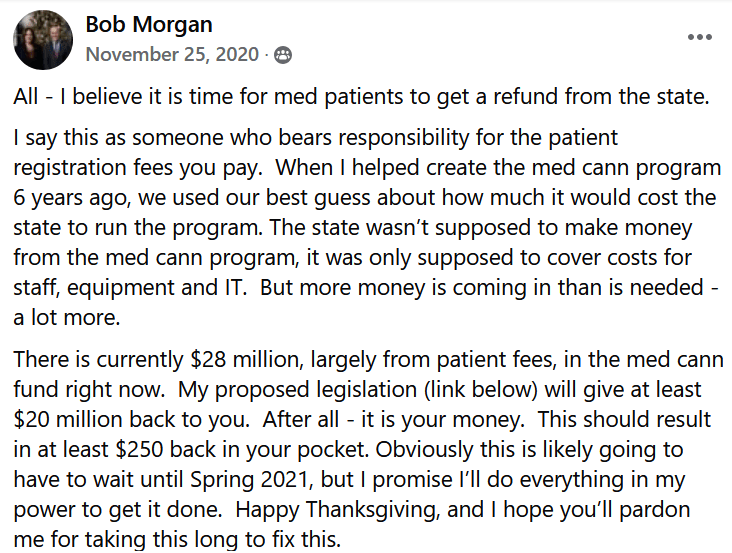
- Before this had occurred, Illinois Representative Bob Morgan signaled that he would be filing legislation that would have refunded excess money from the Compassionate Use of Medical Cannabis Fund directly to Registered Medical Cannabis Patients.
- This idea has yet to come to fruition.
- Before this had occurred, Illinois Representative Bob Morgan signaled that he would be filing legislation that would have refunded excess money from the Compassionate Use of Medical Cannabis Fund directly to Registered Medical Cannabis Patients.
- Waived annual license fees for existing cannabis transport license holders from January 1, 2024, to January 1, 2027.
- Imposed a moratorium on new cannabis transport license applications, prohibiting the Department of Agriculture from accepting any between January 1, 2023, and January 1, 2027.
- In December of 2024, MarijuanaMoment reported that Female Orgasmic Disorder had officially been approved as a qualifying condition for medical cannabis.
If I missed any major milestones, let me know!
I wrote this article to explore what the future of Illinois cannabis policy could look like while reflecting on how we arrived at this point. Feel free to share your thoughts in the comments—whether about the past, the future, or anything related to Illinois cannabis policy.
Illinois Representative Bob Morgan Comments on Potential Refunds for Medical Cannabis Patients
Fact Sheet on HB1443 from Illinois Cannabis Regulation Oversight Office
 The Cole Memo
Leave a comment