
Article updated at 4:20PM on 05/25/2024 to include a statement from The 1937 Group & Parkway Dispensary
From what I can gather, HB2911 is being referred to as the cannabis omnibus. The bill contains several provisions that advocates and industry participants have been pushing for.
Despite its support base, the bill has encountered opposition from influential stakeholders. According to Illinois Cannabis Equity Coalition(CEIC), Green Thumb Industries(GTI), a licensed cannabis operator, is actively opposing the measure due to a provision relating to medical cannabis patients. As a result, CEIC is calling for a boycott on GTI.
The Illinois Sheriff’s Association’s (ISA) also raised concerns about the cannabis omnibus, citing language that related to the odor of cannabis. ISA’s reservations regarding this element of the bill would maintain the criminalization of cannabis in Illinois. This move has yet to stimulate conversations among the state’s cannabis enthusiasts and media circles as it has gone largely unreported.
- Illinois Sheriff’s Association Objects to Removal of “Odor-Proof” Language
- Green Thumb Industries Lobbies Against Social Equity (Again?)
- Response from Green Thumb Industries
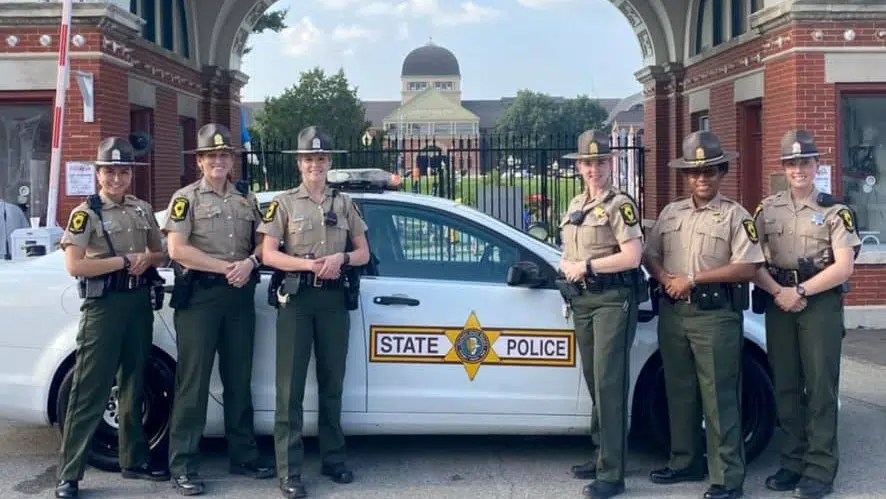
Illinois Sheriff’s Association Objects to Removal of “Odor-Proof” Language
Background
In 2020, the Cannabis Regulation and Tax Act officially became the law of the land. Prior to the new law taking effect, possession of 10 grams or less of cannabis was punishable by a small civil fine between $100 and $200. The new law, dictated that possession of cannabis in a motor vehicle could result in a Class A Misdemeanor if the cannabis is not in a sealed, child-proof, odor-proof container.
The challenge lies in the fact that there is no such thing as a truly odor-proof container. It is self-evident that the products, which are prepackaged, are not odor-proof. This is why the scent of cannabis is detectable when entering an Illinois dispensary.
As a result, based on discussions I’ve had with legal experts, the moment you purchase a cannabis product (like flower) from the dispensary and enter your vehicle, you will find yourself out of compliance with the law. From what I understand, consumers are less likely to encounter odor-related issues with cannabis edibles, as they generally do not emit a strong cannabis scent and are less aromatic compared to fresh flower products.
Attorney Galholtra hosted an event, which I attended, on this exact subject. I have also discussed this subject with cannabis defense attorney Evan Bruno. Evan wrote an article on the shortcomings of Illinois’ cannabis law, which can be found here.
Objection
On May 23, 2024, there was a hearing on HB2911 in the Senate Executive Committee. During the hearing, the sponsor of the bill spoke, along with proponents and opponents.
Jim Kaitschuk, a representative for the Illinois Sheriffs Association, voiced his opposition to language that would address an issue that continues to criminalize cannabis consumers in Illinois. To satisfy the objections raised by police, the “odor-proof” language was added back to the bill.
In other words, the “odor-proof” language will remain part of the law. As a result, cannabis users should exercise an abundance of caution when traveling with cannabis in a motor-vehicle.
Supreme Court Ruling
If objections by law enforcement prevent us from addressing this via the state legislature, our last resort to remove this language from the law may hinge on a ruling by the Supreme Court of Illinois.
On January 10, 2024, the Illinois Supreme Court heard arguments regarding whether the smell of cannabis-alone justifies police officers searching a vehicle. You can watch the hearing here.
I recapped the hearing with legal professionals on episode 49 of The Cole Memo Podcast. During the episode, attorneys discuss what was said during the hearing and provided their predictions for the future.
The legal professionals that I spoke to ultimately predicted that we would see an unfavorable ruling. In other words, they predicted that “odor-proof” language will remain in the cannabis law as a result of the Supreme Court Ruling.

Green Thumb Industries Lobbies Against Social Equity (Again?)
On the evening of May 25, 2024, I received a flurry of messages from advocates regarding alleged opposition from Green Thumb Industries on a provision that would allow medical patients to shop at all dispensaries.
Based on reporting by GrownIn, this is not the first time that GTI has been accused of opposing legislative proposals that were supported by social equity licensees.
GTI reportedly pushed back on the notion that they lobbied against social equity, according to GrownIn.
GTI representatives claim their opposition was heartfelt, claiming they were working on behalf of social equity applicants, in an attempt to ensure social equity applicants get an equal shot at obtaining plum dispensary locations, rather than allowing existing dispensary owners to snap up all the best spots.
Background
Based on information that has been shared with me, medical patients are currently not able to purchase cannabis at the medical tax rate at all locations due to a technical issue that exists as a result of how the adult-use law was drafted.
Below is a statement that was made by Illinois Representative Bob Morgan. This statement gives some background on this issue.
This is the only issue, of all of the things that we are discussing, that will directly benefit medical patients in Illinois. There are 150,000 or so active medical cannabis patients. The medical cannabis program has been active since 2014. It has, of course, evolved as the adult-use program has grown.
But, there are still 150,000 patients in Illinois, who have cancer, ALS, Crohns, PTSD, and other serious medical conditions who use the medical cannabis program for access to their medicine, which is not covered by insurance, it’s very expensive, and worst of all, which is why we’re talking about this, they cannot go to (more often than not) their local dispensary to buy their product. They have to go to one of the original 55 dispensaries to do so.
The reason for that is a technical problem from the drafting of the adult-use program in 2019. Where we defined three different categories of dispensaries: the original 55, the second-site location for those original 55, and then forever after: every new social equity dispensary. Those are the three categories. Under the law right now, medical cannabis patients can only buy at the lower tax rate at the first 55 because of how we defined that in the 2019 law.
So, the functional impact on that, for these patients, who sometimes are wheel-chair bound, often are working from home because of their disability and because of their medical condition–they have to drive sometimes hours to a dispensary to get the medicine that they need at the price that they are owed because the state of Illinois established that. So, I wanted to give some historical context here.
There have been some private conversations expressed to me and others with concerns about this element, and before we open up to other comments, I think it’s important to note that Leader Lightford has been doing an incredible job corralling a lot of people, and frankly, a lot of lobbyists with a lot of businesses interests across this industry in a lot of ways.
Our meeting a few nights ago had, I think, over 35 lobbyists, and not one of those lobbyists represent medical patients. So they are an unrepresented entity here. But there are 150,000 of them in Illinois. So this is language that I asked CROO to come up with, and they did exactly what I asked them to do. There is support of this by members in the House and the Senate, as there has been for many years for medical cannabis patients. I’m asking for this language to stay in the bill.
Representative Bob Morgan
Senator Kimberly Lightford responded to Representative Bob Morgan with the below statement.
Thank you Representative. So, you are the voice for this population. So, I do not consider them to be unrepresented.
Senator Kimberly Lightford
CEIC Calls for Boycott on GTI Products & Stores
Below is what I received from the Cannabis Equity Illinois Coalition (CEIC).
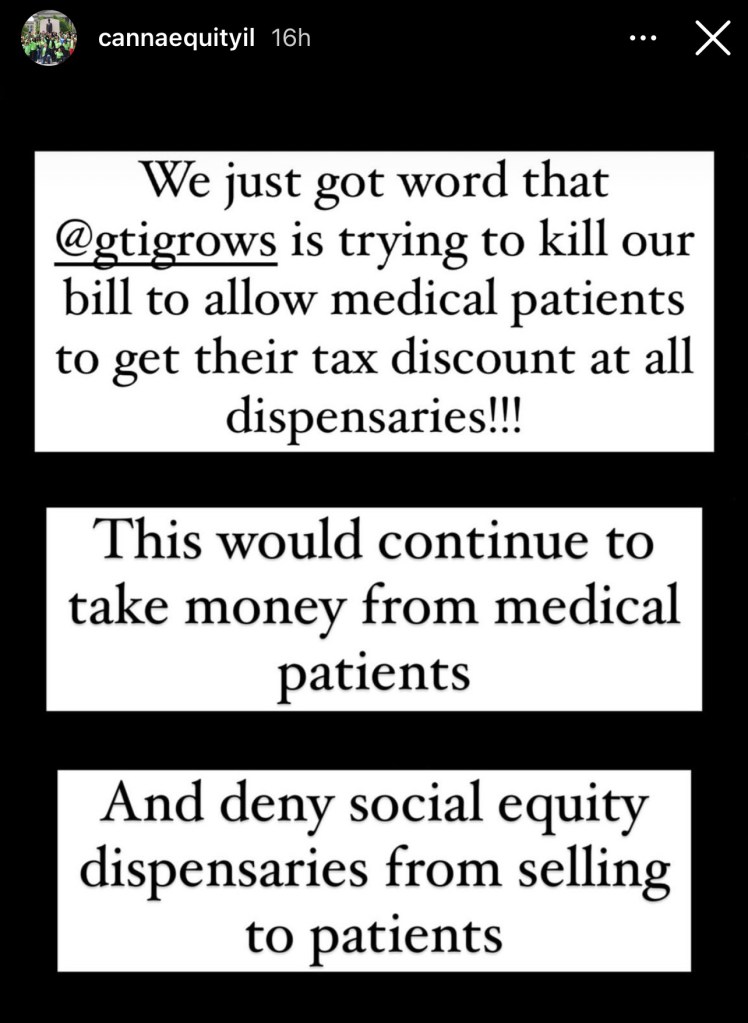
Hello! I wish I could call you with better news, but I just got word GTI’s lobbyist is trying to block our bill to allow medical patients to get the tax discount at all stores. I was told they hired 12 lobbyists. This is deeply troubling, and we’re asking you to help boost this information in your network, boycott their products & stores, and call your state rep & Senator
Quote by Cannabis Equity Illinois Coalition
Statement from Illinois Independent Craft Growers Association
Scott Redman, representing the Illinois Independent Craft Growers Association, provided comment regarding GTI’s apparent opposition to the provision.
GTI has apparently chosen to put its weight behind a change that will greatly and adversely affect 140,000+ medical card holders and hundreds of social equity businesses. This has to stop. Our legislators need to focus on patients and not on those companies that lobby the hardest.
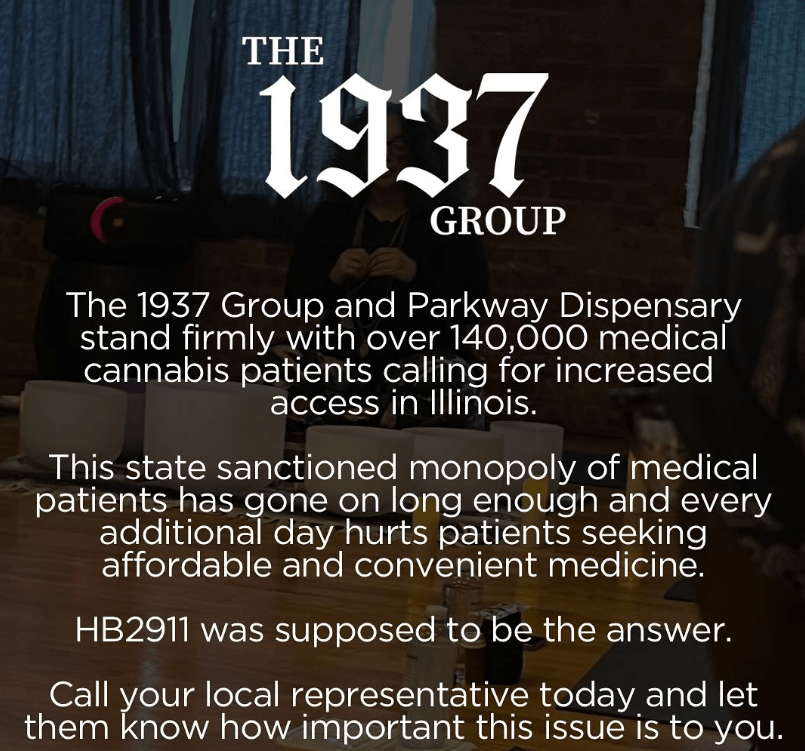
Statement from The 1937 Group
The 1937 Group posted a statement on social media.
Response from Green Thumb Industries
I reached out to a representative of Green Thumb Industries for comment on the allegations that have been made by others in the cannabis community.
I expect to receive an official response from GTI after the holiday weekend. I will update this story once I have received a response.
Update: according to the Chicago Tribune, GTI issued a response.
Green Thumb issued a statement that it has always supported patient access to legal cannabis.
“We have a history of championing patients, including leading advocacy efforts to ensure patients could access their products during the pandemic, and most recently, preserve curbside pickup services for patients,” the statement read.
The proposed measure, HB 2911, GTI said, “included language that was neither operationally viable nor comprehensive enough for what Illinois patients deserve, such as requiring patient lanes or offering delivery services. Illinois legislators recognized the concerns and will continue working on this with the goal of passing it during veto session (this fall).”
Read full article here
Comment below with your thoughts!

You can support The Cole Memo with a one-time, monthly, or yearly contribution.
Support The Cole Memo by making a one-time contribution
Support The Cole Memo with monthly contributions
Support The Cole Memo with yearly contributions
Choose an amount
Or enter a custom amount
Your contribution is appreciated. Your contribution helps us afford equipment to capture our content and hosting fees to distribute our content.
Your contribution is appreciated. Your contribution helps us afford equipment to capture our content and hosting fees to distribute our content.
Your contribution is appreciated. Your contribution helps us afford equipment to capture our content and hosting fees to distribute our content.
DonateDonate monthlyDonate yearly
#258 – The Reality of Being a Craft Grower in Illinois – The Cole Memo
- #258 – The Reality of Being a Craft Grower in Illinois
- #257 – Illinois Cannabis Sales Drop as Lawmakers Revisit Search Rules
- #254 – Announcing the Midwest Cannabis Forum + Other Discussion on Cannabis Policy Today
- #256 – Illinois Cannabis Reform 2026: What Advocates Want and What Might Actually Move
- #255 – Arrests Keep Coming in “Legal” Illinois
 The Cole Memo
Leave a comment