
On April 11, 2024, the Cannabis Business Association of Illinois held a press conference in Springfield, Illinois.
On display, as pictured below, were products that were obtained from an unnamed source.
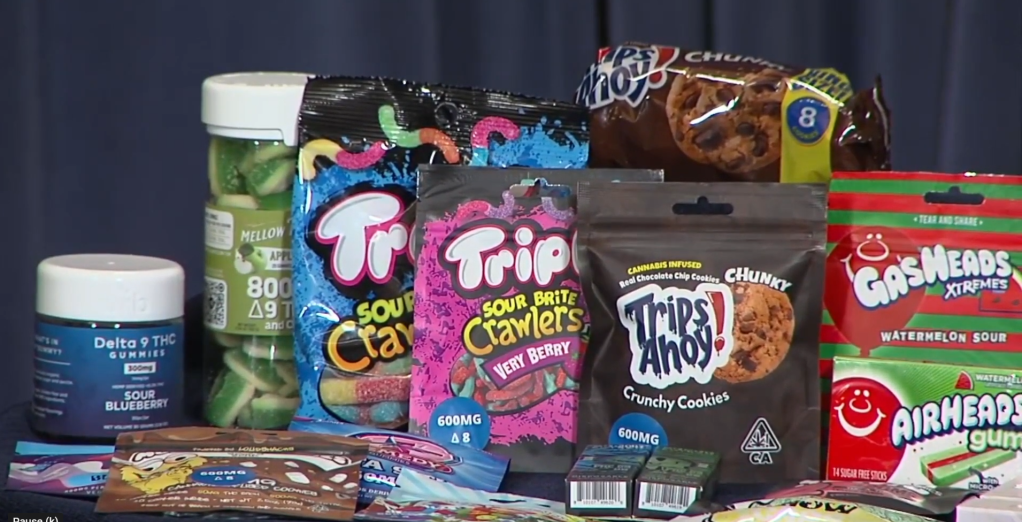
Below is a transcript of the press conference and the Q&A. This transcript is a representation of spoken words.
Statements
Click to read full statements
Tiffany Chappell Ingram:
“Good morning, my name is Tiffany Ingram, I’m the executive director of the Cannabis Business Association of Illinois. I’m here today with a coalition of researchers, safety advocates, cannabis license holders, and lawmakers to introduce the Hemp Consumer Protection Act. This act is twofold. It creates a regulatory framework for hemp consumer products such as CBD, so: non-intoxicating products, therapeutic products, and temporarily prohibits the sale of dangerous synthetic THC intoxicants, including Delta 8, pending further study.
I appreciate you taking the time to be here today, and I’d like to extend a special thank you to the legislators that took some time out this morning to be here. I’d like to acknowledge Representative Smith, Senator Villanueva, Representative Hernandez, Representative Morgan, Representative Delgado, and Representative Hammond.
You know, over the last several years, there’s been a proliferation of unregulated THC products. These products can be found in corner stores, gas stations, bakeries, and even unlicensed retailers that hold themselves out to be dispensaries. That’s created a lot of consumer confusion. You know, however, things aren’t what they seem. This is case in point here.
On one hand, I have… they look like Fritos, right? Corn chips. These are the corn chips, and the other contains 600 milligrams of Delta 8. I beg to differ, my daughter wouldn’t be able to tell the difference, which is extremely intoxicating.”
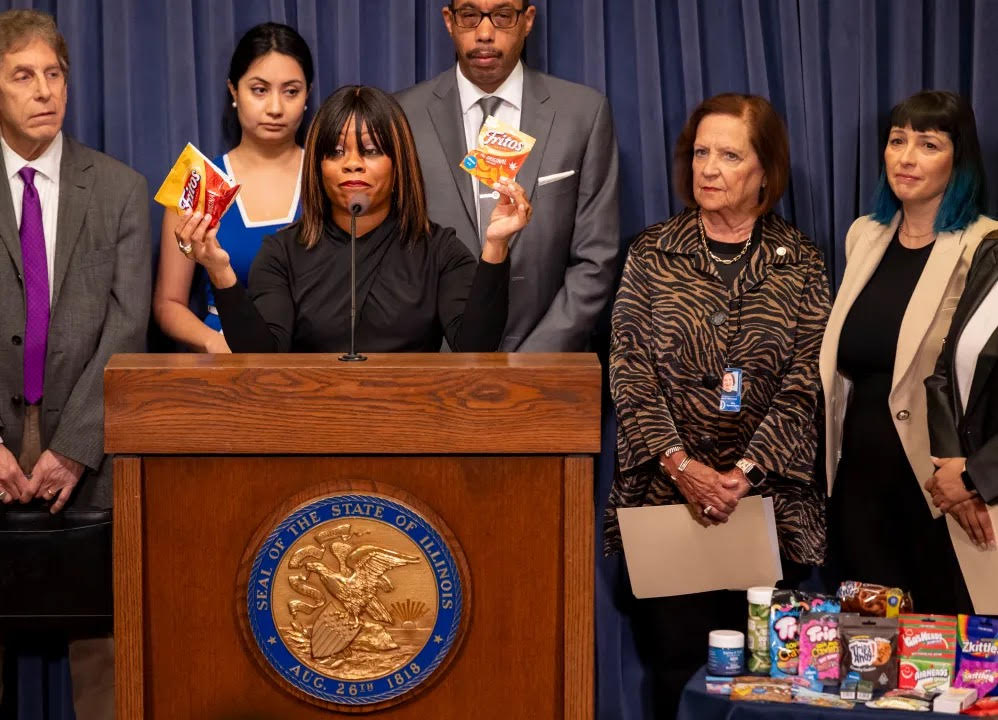
Note from Cole: In the past, Chicago’s Mars-Wrigley has reportedly sued for cannabis packaging or naming that infringes on copyright. Read reporting by Chicago Sun-Times here.
Tiffany Chappell Ingram:
“You know, the packaging looks identical, and you know, this poses a threat to children and it confuses the two, and it can cause problems for consumers of all ages. There’s no guarantee what’s in the package, there’s no guarantee what’s in the product. Our legislation seeks to address that. First, we want to create a regulatory framework for hemp consumer products such as CBD, establishing standards for licensing, testing, and labeling akin to what’s already in place for cannabis. That means consumers will have a guarantee about potency, ingredients, and quality. It also means intoxicating products couldn’t be marketed or sold to minors. That are attractants like this, like cookies and familiar snacks.
Second, the legislation would also prohibit the sale of Delta 8 and other synthetic THC intoxicants like what’s allegedly here. What I like to say is “Frankenstein weed” is created through a chemical process that amplifies potency of hemp. The result is an intoxicating product often many times more intoxicating than what actually licensed cannabis dispensaries can sell. Researchers have similar products found that there were well over the legal limits of THC and the hemp products as dictated by federal law and contain things like heavy metals and lead. You know, this is why Illinois needs to push pause on these products and so health and policy experts can study in more depth and decide if there’s a way to make these products sold and consumed safely and legally. We need to push pause. The goal of this legislation is to empower consumers ensuring that they know exactly what they’re consuming and what they are. We also want to protect the public health and maintain the integrity of our state’s long fought for legal cannabis industry, which is undermined by these under unregulated products. I’d now like to turn over the podium to our chief sponsor, Representative Nick Smith, for more information about the legislation. Thank you.”
Representative Nick Smith:
“Good morning. I’m Representative Nick Smith of the 34th District, which stretches from Chicago’s south side all the way down to Kankakee County. I’m proud to sponsor this Hemp Consumer Protection Act, which will create a long overdue regulatory framework for the sale of unregulated THC products that has created confusion across the state and put consumers at risk.
Licensed cannabis businesses regulated by the state have gone through countless steps to ensure they are operating safely. They adhere to detailed rules, including product quality control and testing, strict bans on sales to anyone under 18, as well as numerous zoning guidelines, including those that prohibit dispensaries from opening next to schools. Applying similar standards to consumer hemp products will allow businesses to continue to sell the safe hemp products many consumers rely on but preventing access to synthetic THC intoxicants that pose a danger to our communities.
This legislation will put in place safeguards for consumers while also protecting the investments made by small business owners across Illinois, including cannabis businesses and hemp retailers. It’s a win-win, and I look forward to working with my colleagues here to pass this common-sense legislation. Thank you, and up next, I’d like to welcome Representative Barbara Hernandez. Thank you.”
Representative Barbara Hernandez:
“I represent the area of Aurora, North Aurora, and Batavia, and the suburbs. In the past few months, we have witnessed stories in the news about children getting sick from synthetic THC. Those children can purchase these items, as stated before, at smoke shops, gas stations, stores, random stores, and it could be of all ages. Currently, it’s not regulated. Many of the products, we don’t know what exactly is in them. We don’t know the ingredients; they are not regulated to list the full ingredients. And as we see here at the table, there are several products that look like items that we have had before: candies, chips, a little bit of everything is there. It’s impacting not only children but it’s also impacting adults. I’ve heard many stories from both families that have had children and just these products but also adults that have had a bad reaction to this. So no one is safe from this. Twenty-one and over is not a valid argument to make. It just has to stop.
So that is something that I know we’re here together and it’s very crucial that the rest of the general assembly comes together to prevent any additional harm from happening to families. I hope today you will join us in pushing for regulation and keep these companies accountable for the careless actions that they have. So thank you, and I will pass it on to Senator Celina Villanueva.”
Senator Villanueva:
“Good morning, everyone. I’m State Senator Celina Villanueva. I represent the 12th District, which is the southwest side of the city of Chicago and a couple of blocks in Cicero. I am actually one of the legislators that helped to negotiate the original cannabis law in 2019. And this was a bill that was painstakingly combed through. It was a very large behemoth of a bill because of the thoughtful conversations and the debate that we had over the years. But again, of all of the people around the table that took the time, and it wasn’t just about decriminalizing cannabis, it was also about the regulation to make sure that people were aware of what they were ingesting. If you look at this Fritos bag, you see a list and you have ingredients. We wanted to make sure that people knew what they were ingesting when they were taking cannabis or using cannabis.
And what’s going on here is what we’re hoping is that the same deliberate and careful approach is necessary as it pertains to regulating hemp products throughout Illinois, especially those that may pose a threat to the health and safety of our communities. These products were never intended to be freely sold to kids at pop-up shops, street fests, bakeries, corner stores. The landscape surrounding hemp consumption, consumer products has been marred by confusion and risk. The proliferation of unregulated THC products has not only confused consumers but has also put them in harm’s way. This situation cannot continue to go unchecked. It is imperative that we take decisive action to establish a regulatory framework that ensures the safety and integrity of hemp consumer products. Without proper oversight, consumers are left vulnerable to a myriad of risks, from unknowingly consuming products with inaccurate THC levels to encountering harmful contaminants. The absence of regulation leaves too much to chance. As advocates of public health and safety, we cannot continue to turn a blind eye on these dangers.
Further, without defined standards and guidelines, businesses operate in a state of uncertainty, hindering their ability to thrive and to innovate responsibly. By establishing comprehensive regulations, we are not only protecting consumers but also creating a level playing field for businesses to compete in a fair and transparent market. It is a matter of public health, safety, and economic vitality. And as representatives of diverse interests coming together for a greater good. It’s really important for us to take the time to be able to create meaningful change. And together, I think we were able to do that, to not only create a safe and reliable ecosystem but to also contribute positively to the well-being of our society. Thank you very much, and with that, I’m going to introduce Joseph Friedman, CEO of PDI Medical.”
Joseph Friedmen:
“Good afternoon, my name is Joseph Friedman. I’m the former CEO of the former medical cannabis dispensary PDI Medical, which stands for Professional Dispensaries of Illinois. This dispensary didn’t go out of business but was sold to one of the big MSOs in Illinois at the end of 2019. I’m also a national speaker and a medical cannabis consultant. As a pharmacist who specializes in medical cannabis, I know firsthand how important it is to have accurate information about the products we’re all consuming.
While it’s understood that the molecules within the hemp plant may have unique medicinal properties, it’s important consumers know exactly what is in the product they are purchasing. Oftentimes, the label doesn’t really match what’s in the bottle. Without regulation, we have no idea what is really in these products. That should be concerning to us all, especially since some of these intoxicating products are chemically modified and widely available to young folks, teenagers, and kids.
There is still so much we are learning about cannabinoids in these products and what they do and their impact on the human body. For instance, we don’t have widespread good information yet about any contradictions with medications that someone might be taking alongside cannabis or hemp, which adds another level of danger. That’s why it’s so critical to be deliberate and thoughtful when it comes to these products. And I’m encouraged by the policy discussions that are happening here today.
One of the things that came out at the end of March 2024, that went out to a number of Representatives that are involved with the US agriculture department, is an understanding and realization that the hemp bill was flawed and you know what’s absent on this document?* This was signed by 19 different attorney generals from states and Illinois is missing on this document so I’ll definitely leave this if anyone is interested in having it. I want to pass this along to Ron Miller, principal owner of Navada.”
*Note from Cole: For a legal professional’s perspective on the document that Joseph Friedman referenced during his speech, you can listen to this podcast episode or read this article.
Ron Miller:
“Good morning, my name is Ron Miller, and I’m one of the co-founders of Navada Labs. We are a family-owned business located in Mount Vernon, Illinois. I was born and raised on the west side of Chicago, and I continue to spend a lot of time there. I experience and I continue to see negative changes on the west side of Chicago. So as a proud person to be born there, I see a lot of these products starting to flood our community, and we know that has a negative impact on the kids and their eventual journey to being adults.
One thing I do want to mention is my family, along with other talented people in the community, went through a rigorous process to obtain our license to be a regulated state dispensary. In doing so, we spent thousands and thousands of dollars, a lot of time, and we maintain compliance to work with the state to make sure that the right products are on the right shelves.
It is deeply disheartening and frankly a betrayal by the state to allow these shops to pop up and call themselves dispensaries.
In fact, my shop is in direct competition with some of these shops that are allowed to sell synthesized THC-intoxicated products, which are just as intoxicating as the products that we sell but half the price and unfortunately without any type of compliance.
I’m not alone. There are over 200 businesses that are trying to enter into the cannabis industry, dispensaries that are licensed. They went through the rigorous application process. They’re just trying to get capital to open their stores, and now they have to compete with an unlevel playing field. So I ask the question, how is the regulated and taxed cannabis industry supposed to be on an even playing field?
The regulations that I must follow on a daily business are to make sure that we protect the public. By doing so, we provide products that are safe, that are high quality, while ensuring that children don’t have access to products that are intended for adult use. These regulations aren’t followed or adhered to by these smoke shops that sell these hemp products, and unfortunately, we find and we witness stories every day of kids who are getting sick by taking these products.
I can tell you this: children aren’t allowed in my dispensaries or other dispensaries, so they aren’t taking any type of intoxicated products. With that being said, we all need to be on the same playing field and follow the same rules. Thank you.”
Note from Cole: It would seem that cannabis testing in Illinois is far from perfect as evidenced by an investigation by Chicago Sun-Times and by recent testimony by a cannabis testing laboratory in the state of Illinois.
Representative Hammond:
“Good morning, I’m Norine Hammond, and I represent the 94th District, which includes 13 counties in the West Central part of the state. I’m pleased to be here this morning to support this bipartisan legislation that will protect consumers, and especially protect Illinois children. When you look at these products that are in front of us, if you sent your child or your child wanted to go to the store for a snack, would you be confident that the snack they are choosing is one that we know what the ingredients are and will not be harmful to that child? I’m not confident that most children are able to do that.
These predatory market practices would never be allowed with any other product, and cannabis products sold in dispensaries have very strict labeling standards. Knowing that these products contain nearly the same or certainly the same intoxicants, but they can be disguised, is frankly quite terrifying to me. And it’s time for us as policymakers to intervene and to protect the consumers, but especially to protect Illinois children. Finally, I’d like to introduce my colleague Eva-Dina Delgado.
Representative Delgado:
“I’m a State Representative in the Third District, which is on the northwest side of the city of Chicago. I wanted to come here today to talk a little bit about a personal experience as a parent. I’ve got a 15-year-old daughter, and I think most folks who were 15 were experimenting with lots of different things. And as a parent, there is nothing more scary than to hear stories from your child about how kids are “Greening out,” this is what they call it, “Greening out.” And when I ask her questions like, “Hey, you know, are these kids getting this supply from their parents?” because you know that’s where most of the alcohol comes from, right?”
(audible laughter in room by at least one individual)
Representative Delgado:
“She says, “Oh no, we just go to the corner store. They pick up, you know, whatever Delta 8 product happens to be there. They can buy it and walk right out. They have no idea what’s in it.” It scares me to my core to think about young people putting things like that in their body and we just have no idea what it is. So again, as a parent, for me, this is something that’s incredibly important because I want to make sure that whatever industry that we have here in the state of Illinois around legalized cannabis continues to protect our children.
I similarly had a conversation with a principal in my district who was also telling me that she was having kids showing up after lunch intoxicated with these same products and they were going to the corner store. She was sending me pictures of them, as a matter of fact, I think I sent them to some of the folks here.”
(audible laughter in room by at least one individual)
Representative Delgado:
“What are these things? Yeah, I mean, it’s too accessible, it’s too available, and we have no idea what it is. And so this piece of legislation, I think, will put us on the right path to be able to require certain things from the producers of these products so that we know exactly what’s in them, so that we can protect our kids from taking them. And again, as a parent, this is something that is very personally important to me, and so I’m looking forward to working all of my colleagues to make sure that this happens. Thank you, and now I will hand it over to Chris Lindsay.”
Chris Lindsay
“Well, I’m Chris Lindsay. I’m with the American Trade Association for Cannabis and Hemp, and I’ve been working on this issue in all parts of the country. Every state is dealing with exactly the same issue that this piece of legislation addresses, and I really appreciate the careful thought that went into it. It’s not closing the door completely; it just says, you know what, we need to understand more about these products to know how we can make sure that they’re safe for consumers and that they’re limited to adults. So, I very much support the direction of this bill and the careful work that went into it.”
One thing that I would like to address just real quick is there is commonly a marketing pitch that you’ll hear from folks that sell products like this, and it’s just to say, “well, it’s federally legal.” And I got to tell you that if you ask somebody at the DEA what they think, they will very much disagree. They see these as synthetic drugs and scheduled. They’re not. Congress didn’t accidentally legalize cannabis.* Rather, this is a lane that got open because of confusion that happened around the Farm Bill, and states are then left to try to impose a system that has no rules. If a state does not have a set of regulations in place to limit these products to those who are 21 or older or… let’s look at what’s in these products, then there are no rules at all. And there really aren’t products available in the United States that have no rules at all. So, it really is important for Illinois to step up and do exactly what it’s doing with this bill, and I’m very supportive of it. Thank you, and with that, we’ll ask Tiffany back to the mic.”
*Note from Cole: For a legal professional’s perspective on the statements that Chris Lindsay made, you can listen to this podcast episode.
Tiffany Chappell Ingram:
“Thank you, Chris, and thank you so much for all of your important contributions to this discussion today. I’d like to open it up for any questions.”
Question and Answer
Click here to read full question and answer
Unknown:
“Shouldn’t there be federal effort on this?”
Tiffany Chappell Ingram:
“My understanding is that there is a federal effort as far as with the new farm bill, but I’ll leave that to Chris to answer.”
Chris Lindsay:
“So, we are talking with members of Congress, and the farm bill is back up. This all kind of got started in 2018 when the farm bill defined hemp as separate from marijuana and then removed it from the schedule of controlled substances. And some folks then said, “Well, then anything that we can ever come up with to do with this plant just must be okay.” And like I said, the DEA and the FDA take a much different view. What we’re asking Congress to do is really just clarify what they did. They did take hemp off of the controlled substances list, but that doesn’t allow the operators to then synthesize controlled substances from that hemp and then call it hemp. And so that’s the conversation we’re having with members of Congress, and we do hope to see a change in the way the farm bill has structured this to more clearly allow states to come in and do exactly what Illinois means to do.”
Unknown:
“So, Representative Ford had this bill last year that actually was a pair of bills that would not ban Delta 8, but it would regulate it, tax it, etc. And his argument was that by banning it, we would create a whole new level of prohibition, kind of undermining one of the goals of marijuana legalization in 2019 to decriminalize. So, how is this threading the needle? How are business owners going to be punished? Is it going to be criminal punishment? Is their business license going to be taken away?”
“If we ban it the way cannabis was banned, then we’re going to have a new crop of people that’s going to be entered into our criminal justice system.” – Representative Ford
Reported by Nika Schoonover in Capitol News Illinois
Tiffany Chappell Ingram:
“Thank you for the question. I do want to acknowledge Representative Ford’s work in this space. He’s been a zealous advocate in the cannabis space, and I do want to acknowledge that.
What I will say is that the legislation doesn’t go far enough. The cannabis industry, the way it’s regulated…it is heavily regulated, and there are certain restrictions in place, or sort of known things, so you can’t have runaway potency. There are certain ingredients you can use, certain testing protocols, tracing involved, all of those things to keep the product safe. We just don’t think Ford’s legislation goes far enough, but we do appreciate his efforts in this space.
We agree prohibition doesn’t work. I mean, we can look at alcohol prohibition, but that’s not to say that we don’t take the time to look at what we’re consuming and make sure it’s safe. And this is the effort to do that. Some will say that this is a ban, but really it’s a pause. The legislation calls for a committee of scientists and other technical experts to look at, can these products be made safely? And if they can, how can we do that? How should they be regulated? And that’s what we’re asking for.”
Unknown:
“So, Delta-8 products are relatively new still, I mean, relatively speaking. Is there a framework in place to test these products? Is it similar to THC? And I mean, what does that look like?”
Tiffany Chappell Ingram:
“You want to take that, Mr. Friedman?”
Joseph Friedmen:
“You know, the whole idea of testing these products for a market that’s not regulated doesn’t really exist.
I went to a dispensary in Lake Geneva; it said dispensary, but I know medical cannabis is not legal in Wisconsin. I walked in, and he goes, “Oh yeah, we have all these certificates of authenticity(COAs) to our products.” But you know, I think it’s important to actually look at those labels, those COAs, to just say, “Okay, is this really lab tested? Have they actually taken a look?” Because you know, when you grow hemp, I mean, it’s grown in soil; there’s stuff that can come up from the soil, like heavy metals and things like that, there’s pesticides, there’s all these things that can be in a plant. And because the medical cannabis industry is so highly regulated, the growers have safe, good products.
I think the whole idea behind the idea of Delta 8 and why it’s become popular is because in far reaches of Illinois, you could be two hours away from a cannabis dispensary, and so, but right down the street, there’s a gas station that sells Delta 8, and that’s just not a good idea. I had a friend, actually, one of my partners in the dispensary, and we heard about this cannabis shop that opened up that was also a bakery, not far from us. And so, my friend went there; it was on Super Bowl Sunday, and it was Delta 8, and they had mild, moderate, and zoomy.”
(audible laughter in room by at least one individual)
Joseph Friedmen:
“So he goes, “Well, let me just have like a cupcake that’s moderate.” So it was 42 milligrams of Delta 8. He took it to his friend’s house, they cut it in half, they each had some, and then they watched the Super Bowl. On Tuesday, they were still high. So, you know, what’s with that? So I hope that answered your question.”
Unknown:
“How does that get tested though? Are there benchmarks in place? Is there a framework that exists too?”
Joseph Friedmen:
“No, because there’s no regulation.”
Unknown:
“So, I guess my question then would be, is this essentially a de facto ban on Delta 8 because if there’s no way to test it, how do you test it?”
Chris Lindsay:
“I think that’s what the committee is…
So, it’s an excellent question, and the process to make THC naturally in a plant, that’s called growing, cutting it down, drying it out, and you’ve got raw cannabis. But to make THC from hemp, you have to take it into a laboratory and do conversions from one thing into an intoxicant, and that process is quite a bit different*. So, to your point, how do you know that those products are safe? And, of course, the answer that you hear a lot is, “Well, we’ll do tests.” But the problem is, to your point, this is so new that a lot of those tests don’t exist yet.
That’s why I really appreciate the way this bill is structured because it’s saying we need to put together a group of individuals who can help figure out what those test panels need to look like, what are we actually looking for. A lot of the tests that are for marijuana are really aimed at cultivation. It’s things like, does heavy metal appear in the plants because that can be in the soil? Are there residual chemicals from the growing process that we want to make sure are out of those products? Well, when you’re doing chemical conversions, those types of contaminants may not show up at all. You’ve got a whole another round of contaminants to look out for, and science is actually only now starting to understand what some of those are. So, that science has to be done for us to have any level of confidence in what those products contain.”
*Note from Cole: THCa hemp allows the consumer to consume THC without a laboratory needed for conversion. You can learn more about the subject here from cannabis industry lawyer, Tom Howard.
Cookies is a cannabis brand that you might recognize from the stores in Illinois. Cookies branded THCa flower is sold via the internet.
Unknown:
“Who would be in charge of enforcing these regulations? In this bill: Is it the attorney general? A State agency?”
Tiffany Chappell Ingram:
“It would be the Department of Agriculture.”
Unknown:
“What makes regulating Delta 8 different than regulating cannabis the way that is right now under state law?”
Tiffany Chappell Ingram:
“So under state law currently there is no regulation because they’re operating under an unregulated space, right? It’s just a virtue of the product that’s created. So, that’s what we’re trying to get our arms around.”
Unknown:
“Does the recreational industry also sell Delta 8 or similar products?”
Tiffany Chappell Ingram:
“I think I don’t quite know how to answer that, but I do understand there’s a lot of cross-pollination in these spaces because the cannabis industry is an extremely hard business to be in. I mean, it’s still not federally legal, um, taxes especially in Illinois are extremely high. So, there are lots of operators, not necessarily in Illinois, that may be operating in both spaces to make ends meet until things change across the country.”
Unknown:
“Businesses that sell Delta 8 are basically saying that you’re just trying to tamp down competition…”
Tiffany Chappell Ingram:
“Correct”
Unknown:
“Can you respond to that?”
Tiffany Chappell Ingram:
“Thank you for that question. We don’t want to clamp down on competition in the sense that if you want to sell hemp, a non-intoxicating product, you’re welcome to sell that. But if you’re wanting to—and I’ll give you an example—I get tons of information from cannabis operators sending me pictures of billboards that say ‘come to my dispensary without the tax”. You have this gentleman here that’s a principal
(Tiffany points at Ron Miller)
Tiffany Chappell Ingram:
“…that put blood, sweat, and tears to get his business running according to state law—licensed, taxed heavily, regulated heavily.
It’s not a competition, frankly. It’s basically a way to destroy the cannabis industry, frankly.”
Unknown:
“So legalizing it was the problem?”
Tiffany Chappell Ingram:
“Say more”
Unknown:
“Legalizing it was the problem, right?”
Tiffany Chappell Ingram:
“I’ve actually heard that argument because I have talked to hemp producers as well. And these are not all like…these are not all hemp producers, right? This is a very complicated industry in the sense that there are folks that are producing different products in different ways. You have folks that are producing products that are perfectly acceptable and safe. You may have heard of like Charlotte’s Web. And then you have products like this. There has to be some rules to the road.”
Unknown:
“What would be the penalties though for a gas station who continues to sell this stuff?
Tiffany Chappell Ingram:
“I can get back…”
Unknown:
“Or for someone who possesses it”
Tiffany Chappell Ingram:
“Well there’s no criminalization for possession. This is just providing an opportunity for regulators to go in…right now they can’t go in and inspect because there is no regulation.”
Unknown:
“How would this bill, you know, regulating hemp or Delta 8, compare to the state’s current cannabis law? I guess are you guys using the framework for that to kind of build the framework for this, or is this kind of completely different?”
Tiffany Chappell Ingram:
“Thank you for that question. It’s kind of both-and. You can think of it like three buckets. We are clarifying what are hemp consumer products, right? So, when I ask an everyday person, ‘How do you know you’re going into a dispensary?’ They’re like, ‘What do you mean?’ I’m like, ‘How do you know you’re going into a dispensary?’ And, like, I would gander to say if you can see the products from the sidewalk, it’s not a dispensary.
That’s confusing. Like, we’re in this space all day so it’s like, you know, I know better, but the everyday person doesn’t. So, clarifying what actually is a hemp product, you know, that’s what this legislation seeks to do: hemp consumer products. So, consumers know when this is like a CBD product, you know? I understand how, you know, what the impact is going to be. I understand that certain ingredients won’t be allowed to be used. I understand that this product is tested. It does that. But then it also says, ‘Hey,’ and folks will say, ‘Hey, this is a ban, right?’ They’ll say, ‘Oh, you’re just, you know, you want everything for yourself.’ That’s not the case. We’re saying that ‘let smart people like this gentleman here study to see what may be the benefits of, you know, artificial or synthetic cannabinoids…’ We just don’t know. And so, we’re like, right now, we’re just saying, ‘Hey, you can just get this.’”
Unknown:
“So, I see in the bill that there’s a $10,000 civil penalty for each offense.”
Tiffany Chappell Ingram:
“Correct”
Unknown:
“The fine, you know, as we know, means nothing if there’s not actually going to be more people, you know, going into these places. Do you think that responsibility is supposed to fall on local law enforcement?”
Tiffany Chappell Ingram:
“This will be the last question. I’m getting the sign… no, go ahead, go ahead”
Unknown:
“Is the responsibility supposed to fall on local law enforcement, or is the Department of Agriculture supposed to hire a bunch of new enforcement teams for this sort of thing?”
Tiffany Chappell Ingram:
“So, you clearly understand state processes. It’s an and, right?
It empowers local law enforcement to look into these things because it’s really at the local level that you’re seeing a lot of this stuff. But also, the Department of Agriculture has the opportunity, with the regulatory authority, to actually go in. Right now, they can’t go in like they can go into a dispensary. They can’t go into a dispensary, but IDPFR goes into dispensaries. But they can’t go in now. But it creates the ability for them to investigate and inspect, which does not exist now. Thank you.”
Professional reporting on this event
- Chicago Tribune, Headline: “Illinois lawmakers call for ban on intoxicating hemp products, but retailers call for regulations”
- Pantagraph, Headline: “Illinois lawmakers look to expand statewide regulations for hemp products”
- WQAD, Headline: “Illinois cannabis business group backs proposal regulating hemp products“
- WANDTV, Headline: “Illinois could prohibit synthetic THC intoxicants, regulate hemp consumer products“
 The Cole Memo
Leave a comment