
In this article, I showcase excerpts from a recent interview with Illinois Representative Carol Ammons. You can watch or listen to the full interview here.
- The Cannabis Legalization Equity Act (CLEA)
- The Cannabis Regulation and Tax Act (CRTA)
- Representative Ammons Speaks Out
- The Continued Criminalization of Cannabis in Illinois
- My conversation with Illinois Representative Carol Ammons
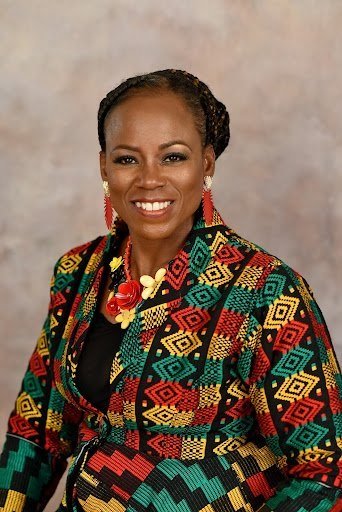
I recently sat down with Representative Carol Ammons. In case you didn’t know, Representative Ammons was an outspoken critic of the Cannabis Regulation and Tax Act of 2019 (CRTA), which decriminalized small amounts of cannabis.
The law also created a system to tax and regulate the sale of small amount of cannabis to adults 21+. The CRTA was much more restrictive than what Representative Ammons had proposed.
The Cannabis Legalization Equity Act (CLEA)
Representative Carol Ammons introduced the Cannabis Legalization Equity Act (CLEA) on January 25, 2019.
The CLEA would have legalized home grow for all adults. The CLEA would have permitted an unrestricted influx of new indoor and outdoor growers while mandating that a majority of licenses for growers and retailers be allocated to minority groups.
Additionally, it would have prohibited cannabis companies or political action committees from making campaign contributions to support candidates or public officials.
The State Journal-Register predicted around the time of CLEA’s introduction that the measure was unlikely to pass because lawmakers were “expected to act on a more restrictive proposal that’s been in the works for more than a year.” – the CRTA.
The Cannabis Regulation and Tax Act (CRTA)
The CRTA was reintroduced as HB1438 on January 28, 2019. The CRTA was co-sponsored by Sen. Heather Steans and Rep. Kelly Cassidy. According to reporting by the Chicago Tribune, the CRTA was widely supported by the existing cannabis industry in Illinois.
The CRTA created a small number of new licenses which were allowed to sell to adults 21+. As Governor Pritzker described, the system purposefully limited the number of licenses because “having too many dispensaries” would mean that people “can’t make money.” Representative Ammons characterized the CRTA as prioritizing economic development over social justice.
Due to objections by licensed growers, law enforcement, and anti-cannabis organizations, home grow was removed for all adults. (Registered medical cannabis patients in Illinois are allowed to cultivate 5 plants at home.)
The Chicago Tribune reported that Illinois law initially barred license holders or their political action committees from contributing to political candidates to prevent perceived undue influence. According to the Tribune, this provision was overturned by a federal judge in 2017.
As a result, key figures in the cannabis industry formed a political action group, channeling campaign finance donations to elected officials in Illinois to support the CRTA over the competing CLEA. A follow up report by The Chicago Tribune revealed that these companies, along with their executives and lobbyists, were connected to over $630,000 in political contributions since January 2017.
Cassidy and Steans, who both received industry-tied contributions, put forward a bill that gave the existing growers the advantage. Cassidy said she tends “to not pay attention” to campaign contributions, and the bill lawmakers passed “is probably the least industry-centered bill” out there. Steans was not immediately available for comment. In late July, Cassidy’s spouse, Candace Gingrich, was named vice president for Illinois-based cannabis company Revolution Enterprises’ newly expanded operations in Florida. Cassidy told the Tribune the House ethics office said there is no conflict.
Chicago Tribune
Representative Ammons Speaks Out
Typically, lawmakers collaborate behind closed doors, often with lobbyists and administration officials, to refine proposals before introducing them as bills and conducting public hearings. When Ammons introduced her CLEA legislation, she reportedly emphasized that her aim wasn’t to disrupt the Steans/Cassidy bill but rather to ensure that any legislation enacted addressed the disproportionate harm inflicted on minority communities through higher rates of drug-related imprisonment.
Representative Ammons indicated that it would be difficult for her to support the CRTA without substantial modifications. She stated, “The conversation needs to shift to how we’re going to address the disproportionate harm in our communities… We want to make sure people who have been criminalized can become part of the economy.”
The CLEA bill, as introduced by Representative Carol Ammons, failed to advance beyond the committee level and ultimately met its end at the conclusion of the legislative session. Conversely, the CRTA, with it’s widespread industry support, passed both the house and the senate.
On May 31, 2019, Representative Carol Ammons delivered a passionate speech, expressing her thoughts on the matter, before the CRTA had officially become law.
The Continued Criminalization of Cannabis in Illinois
In 1978, the General Assembly crafted a law that gave “wide latitude in the sentencing discretion” to the courts and established penalties in a sharply rising progression based on the amount of substances containing cannabis involved in each case. This law is known as the Cannabis Control Act of 1978 (CCA) and is largely still in effect today. Lawyers tell me that the CCA serves as the primary enforcement mechanism for the CRTA.
Representative Ammons accurately predicted that criminalization of cannabis would continue in Illinois. Ammons attributed this reality to the narrow focus of the CRTA. Ammons has made the case that the CRTA prioritized economic concerns over criminal justice reform. Illinois Defense Attorney Evan Bruno has written about this issue, confirming Ammons’ concerns from the front line. Defense Attorneys Bruno and Kulmeet Galholtra have both spoken at length about their experiences defending individuals against the ongoing criminalization of cannabis in the state of Illinois on my show.
I’ve created a short page that showcases several instances of Illinois’ ongoing cannabis criminalization that we’ve previously covered on the show. Take a look here.
My conversation with Illinois Representative Carol Ammons
I recently had the privilege of sitting down with Representative Ammons. Given her prescient forecast on the CRTA, I wondered how she felt about the current cannabis landscape in Illinois.
The conversation has been lightly edited and condensed for clarity. If you’d rather watch or listen to the interview, click here.
Please introduce yourself to my audience
I am Carol Ammons, the representative of the 103rd legislative district in Illinois. I have been in office for 10 years, and this marks my 10th year of service as we close out this session. I am up for another two years in the next term.
It’s been four years since Illinois enacted legislation to decriminalize small amounts of cannabis and establish a framework for its taxation and regulation. Many people call this “legalization”, but I refuse to because I don’t think that we should call it “legal” if you can still get arrested for simple possession, cultivation, or use. Now that some time has passed, what are your thoughts on the impacts of this measure?
I agree with you. I don’t know if you know this, but I introduced alongside some of the other legislative initiatives House Bill 0902 way back when we began talking about this. I believed in a couple of things that should have been inherent. Once you say that this is legal—and I’ve learned this from some really great friends out of Connecticut who were way ahead of Illinois on these questions—once you say something is legal, like alcohol is legal, yes, you can be arrested if you are driving under the influence, but for no other reason can you be arrested for alcohol, right? And I saw cannabis in the same way.
Now, I don’t have a long personal history with cannabis myself. I didn’t smoke or drink at all. So, that’s not something that I have personally experienced. But, what I witnessed was the criminality that was using cannabis to identify certain communities and to use the justice system against them because of their use of cannabis.
I thought that when we passed legislative measures on cannabis, that we would legalize completely, which we have not done. We’ve seen people continuously be charged with having too many plants in their basement. We had a case in Rantoul, Illinois, just north of Champaign-Urbana, where a woman was caught growing more than the allowable amount. All of this is capitalism at its best, that’s what it is, because the reality is if you say this thing is legal, if I can grow six broccoli plants and nobody comes and arrests me for it, why can’t I grow marijuana plants in my backyard?
Why would I be arrested for that, except that the cannabis industry that is driven by capitalist motives are able to make it illegal for me to do what I’m doing so that they can corner the market? That’s all it is. And we’ve seen this over and over and over again in so many ways. This is why I have been in staunch opposition to any cannabis legislative initiative that does not go back and fix the original problems.
Why do you think your bill didn’t garner widespread support, especially considering that it’s a better, more progressive bill that would have more effectively addressed the root problem, the criminalization of cannabis.
The industry didn’t write the bill…that’s why it didn’t get more support.
We had many public hearings around the state that sold the current legislation, the initial bill, as if that bill was going to bring equity and justice. They called it a reparations measure, which I completely oppose that concept. They said that it was going to bring multiple millionaires into the black community. It did not. They said it was going to bring opportunities and jobs to black people in this great new industry, which it did not. And even currently, there is no measure to track the equitable hiring practices in the industry.
They knew from the very beginning that this was going to exclude certain communities, and I attempted to highlight that all the way to the final vote on the first bill. I tried to emphasize it up until the final vote was taken, telling people not to vote for it because it is not going to create what propaganda was suggesting. They refused to hear my concerns. And now here we are in 2024, still trying to correct what we knew and were warned about from the low-interest loan fiasco that they did to the licenses of equity holders.
This was really kind of common sense. When they proposed this, I looked at the Gold Rush and the Homestead Act. I went back to those pieces of legislation because they created the greatest transfer of wealth to White hands that existed in the 1800s. When you look at the Homestead Act, they wrote eligibility in a similar fashion. You needed $13 to $16 ultimately to benefit from the Homestead Act in 1864. So, how many Black people in 1864, who were enslaved until 1865 or 1866, are going to benefit from the Homestead Act? We did the exact same thing in policy in the 1800s that we did with cannabis in the 2000s.
I watched the speech where you made it very clear why you opposed the CRTA. You said ‘I call on my colleagues to look at this issue as a justice issue and not a revenue one.’…
Yeah, this is the moment where we saw the great the Rush of our era, right? The War on Drugs has devastated black communities across this nation and put us into what we considered a permanent underclass position. And so here we come with this industry that black people have been in, whether we like it or not, illegally for generations because there’s no economy in the black community. The only economy that comes to the black community are these kind of exploitative things like crack cocaine and cannabis. This is what we have to sell as a commercial product because you’re locked out of all other industries, right?
And so when you look at the transfer of wealth in the drug industry, it is not in the hands of black people. We’re still being arrested for it, but it’s not in the hands of black people who were overwhelmingly sent to the penitentiaries across this nation as a result of possession of the very thing you’re selling by the tons today in the hands of the white majority, right?
If I could distill it, it’s as if we issued a limited number of golden tickets and we’re saying, ‘Hey, this is going to repair the harms that have been caused on the war on drugs.’ And I think you and I are both arguing that maybe to repair the harms of the War on Drugs, we end the war on drugs?
Exactly. How about that? How about just ending it, right?
The process has been so convoluted. I remember the day that the medicinal license-holders received their unabated access to the recreational market. I remember the day in Illinois where they were running around visiting dispensaries and clapping their hands about how great it is that Illinois is going to “lead on equity”. I mean, these are things that you can look up in any newspaper of the time, and you’ll see how we lauded this great thing that Illinois has done to bring equity and justice.
And you know what? I don’t call a piece of the taxes for nonprofit organizations equity and justice. I do not call that equity and justice. So because you took some of the tax money and you created what we call in Illinois the R3 program? And if you look deeply, Cole, and I encourage you to do it: look deeply into the dispersion of the dollars, the distribution of those dollars that come out of the R3 program, look very deeply into the organizations who receive the majority of those dollars. You would also see a very similar pattern that the nonprofit industry comes in big industries that are supposed to serve the black community, receives the lion’s share of even those dollars.
And guess what? The black community still looks the same today as it did in 2021. And it hasn’t changed the number of black people being arrested and stopped for the War on Drugs at all.
My friend has pointed out something that I never really thought about. The R3 fund is extremely ironic when you consider the source of those tax dollars are coming from cannabis users. We’ve essentially forced cannabis users, who have themselves been typically disproportionately impacted by our drug policy, with picking up the tab for the state.
Right! It’s coming from those who go to the dispensaries.
But to your point, as evidenced by research by James Swartz, Ph.D. at the Jane Addams College of Social Work at the University of Illinois in Chicago, arrests persist predominantly in areas without cannabis dispensaries. Coincidentally, these areas have historically shouldered the brunt of these enduring policies.
You can go to Chicago and see this happening constantly.
Our cannabis regulation oversight officer(CROO), has recounted hearing discussions at a cannabis regulation conference about cannabis operators in Michigan facing receivership (also known as going out of business) and enduring significant price compression, meaning prices are falling due to their regulatory framework. CROO mentioned that the office works every day to ensure that these types of things do not occur in Illinois. The CROO made it clear that they felt Illinois’s limited license approach is the key factor preventing such challenges from arising in the state. So: it sounds like two metrics of success that they have is 1. keeping people from going out of business, and 2. is to prevent price compression.
I’m curious, what do you think about this idea? If those 2 factors are a part of the state’s metrics for success, maybe stopping arrests should also be a metric for success in legalization?
I don’t think that was the focal point, even though part of the cannabis legislation was to clear the records of thousands of people who had cannabis arrests on their records. That part of it still hasn’t been finished…and it can’t ever be finished because we’re still arresting people for cannabis.
So, on one hand, we say that we are addressing equity by clearing the records of thousands of people who have a cannabis-offense on their records, but at the same time: we’re still arresting people and putting cannabis-offenses on their records.
It’s crazy. If you recall, in my bill, we had automatic expungement, meaning you don’t have to do anything to clear your record. And, we were not going to arrest anybody for it.
I believe that we should allow people to grow as many plants as they can manage. It’s not easy growing plants, as we know. This is not an easy thing to do. But if you so choose to grow plants, you should be able to grow as many as you are capable of growing. Why would we limit that? Why are you forcing everyone to these high-priced dispensaries so that we can pay this high price tax, so that we can generate revenue to give back to the same companies that we’re already giving grants to in the state of Illinois for other things, right?
There’s no real effort to stop charging people and arresting them. There’s no effort to allow people to have the freedom of expression when it comes to a plant. This is a plant, and they should have freedom of expression. If they want to grow it, they should be able to do that.
And this concept of keeping the licenses constricted, that’s the part that reminds me of an earlier period of time, the Gold Rush, right? The Homestead Act. These constrictions that the government is going to control who can get in and who cannot get in, that’s part and parcel to the reason why you have already seen social equity people going out of business.
The reality is, those social equity people had to stand up on the same platform that the established licensees had. No competition was in their arena. So, if you think restricting the licenses is the way for you to bring social justice into the space, I totally disagree. The established medicinal licensees had a two-year head start. When we came along with this new license for recreational, what I argued for at that time was that since they already cornered the medicinal space, we’re going to give these recreational social Equity people a year advantage to build their businesses. We’re going to give them the low interest. See, this is where I’m going with it. So, I’m saying give them the advantage that you gave to these medicinal people for two years. We didn’t do that.
You’re still going to be fighting this even when I’m no longer a legislator. They’re going to still be fighting to get into this cannabis industry in all kinds of backdoor ways. We’re going to be passing legislation from here to eternity because what they have done is locked people completely out by policy.
Why do you think that you’re alone when it comes to supporting meaningful reform?
Oh Cole… let’s see, why am I alone? Mary Flowers and I are two of the only ones who voted against the CRTA. Some of my colleagues regret it to this day. They have shared with me personally that they regret voting for the original bill, the CRTA.
We’re alone because just like any other commodity in the capitalist system, unless you deal with campaign finance, you’re going to be alone. I know intimately how this game is played and whoever pays plays. I totally understand how this works. So, you’ll look and say, ‘Oh, you know, these people don’t really support her campaign.’
No, because I don’t ask them to.
There is a real fundamental problem in every state in this Union and it is called campaign finance. And unless we deal with campaign finance, people believe that they elected me and sent me to represent their interest from our community, right? But in many, many cases, the people who are in Springfield are lobbyists and they represent the interest of the cannabis industry.
We will still continue to try and pass laws, and you’ll see new ones prop up this session that are supposed to “clean up” the state’s cannabis legalization law by expanding diversity on the state’s restore, reinvest, and renew oversight boards. See, all of these things are connected, and as long as there’s an opportunity for the majority to receive the lion’s share of the capital, that is how it will work.
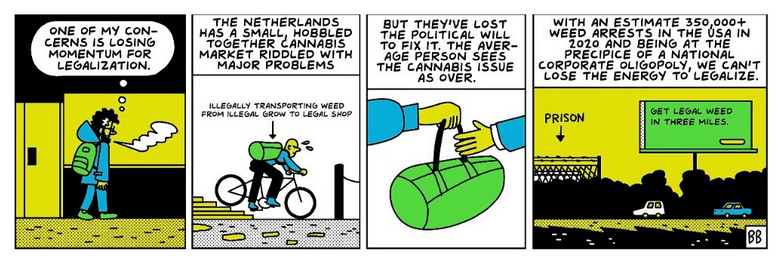
*to help make my point for my next question, I showed Representative Ammons the above comic strip by Brian “Box” Brown.*
It seems like the average person sees the “cannabis issue” as over because you can purchase cannabis from dispensaries in the state. It almost feels like we have become apathetic to meaningful reform in cannabis policy. What is your perspective on this matter?
I have encouraged those who are in the social equity space, these smaller black and Latino vendors that I meet with regularly when they reach out to us. I have encouraged them to not lose sight of the point of legalization. It was supposed to provide an open door, a fair access point to entrepreneurs and business people to become legal, to get rid of the illegal market, and bring an opportunity for people to be legal on the state level, national level, whatever. That has not happened. And what I have seen, similar to the comic strip, is that some of these folks in these smaller groups who are trying to push for more equitable legislative measures, I think they have lost their momentum.
I feel that they have lost their momentum because every bill that has come out, as long as that bill does not allow them unfettered access to a market that you’ve given unfettered access to white majorities, unless you create that parity, you’re going to always be fighting to get into an industry where you are unfortunately outmanned and outgunned because you don’t have the lawyers and you don’t have the revenue to challenge these big industry giants that have taken over the market. That’s my concern as well. I don’t see the push from the grassroots that was there to provide this opening.
The grassroots did this, but the corporatists came in and took it, and the policymakers allowed it. So, the grassroots founded it and for generations have been saying cannabis should not be illegal since the 1920s. So, the grassroots built it and then the capitalist oligarchs came and took it with their paid-for elected officials.
That’s how this works. And I am concerned. This is why I have not voted yes on a cannabis bill. What we have seen is that they have continuously allowed for them to maintain what they have without having to open it up to the rest of us.
Before I go, did you have a good time speaking with me today?
I had a wonderful time. I hope that we can touch base again by the end of session. I’m sure there will be many things that are being asked for in the Cannabis space and we’ll have much more to talk about.
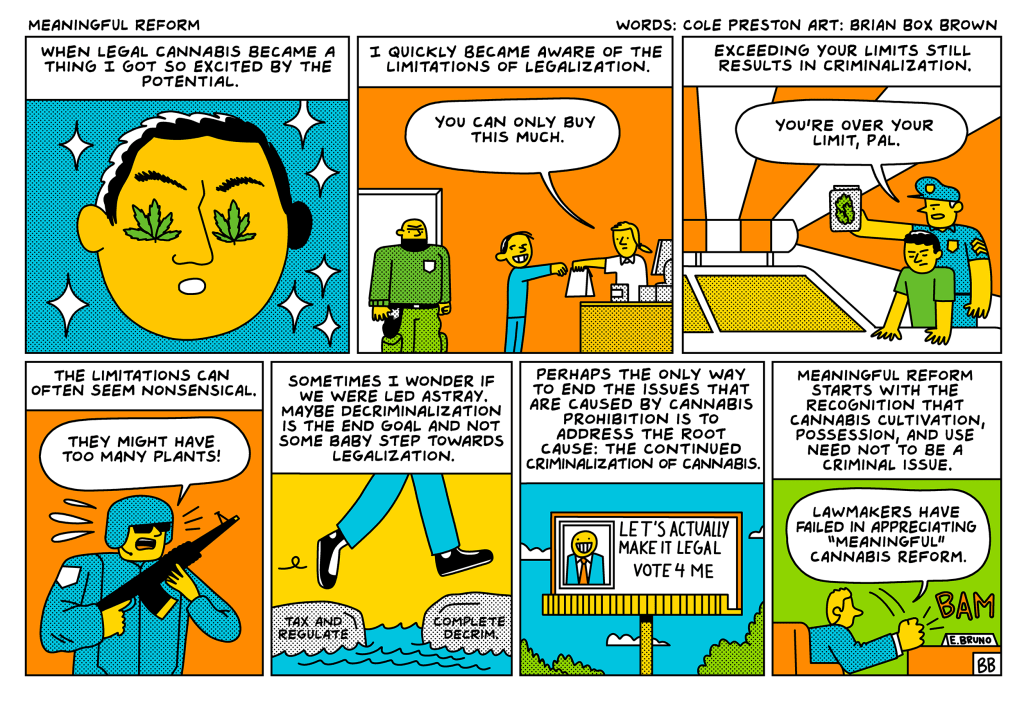
Watch or Listen to the Interview
You can watch or listen to my interview with Representative Ammons here.
I have interviewed victims of the continued criminalization of cannabis in Illinois. You can see that content here.
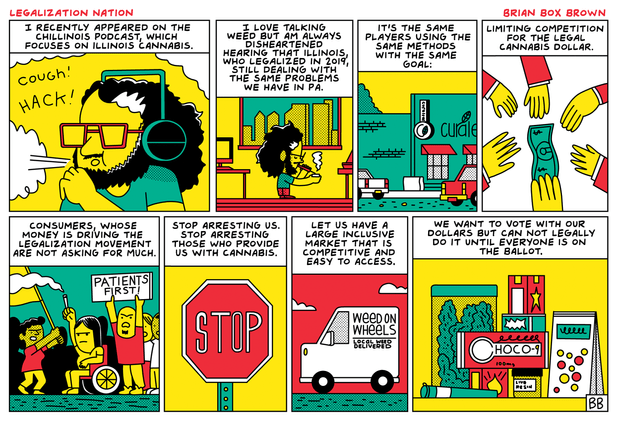
More from Brian “Box” Brown below – from the week of 3/7
- Episode 269 – Inside Springfield: How Lobbying Really Works
- Episode 268 – Cocaine Cash in Illinois? + Latest Cannabis Policy Updates
- Episode 267 – Illinois Odor Laws, Alcohol Lobby Pushes to Halt Hemp Ban, Indiana Governor Signals Legalization
- Episode 266 – The UIC Lab Scandal and Cannabis Law Confusion in Illinois
- Episode 265 – Arrested during Michigan Weed Run, Illinois Lawsuits, and a Market Shakeup
 The Cole Memo
Leave a comment