
It’s the most wonderful time of the year, and I’m not just referencing the recent holiday season. This is the time when legislators make their way back for spring session, a period ripe with opportunities and developments. As we approach the buzz of a legislative session, I’m thrilled to share that I’ve gotten my hands on the recently released Cannabis Alliance One Pager for 2024, a collaborative effort by a coalition of organizations.
The call to action from the Alliance for Cannabis Equity: share this one pager with your state representatives and urge them to support these proposals.
The Alliance for Cannabis Equity includes community advocates, entrepreneurs, trade associations, and other stakeholders fighting for cannabis equity across the State of Illinois. We are dedicated to repairing the harms from the War on Drugs, and ensuring equity in the cannabis industry.
This collaborative effort is signed and led by groups such as the Cannabis Equity IL Coalition, Chicago NORML, and numerous others. (see below list)
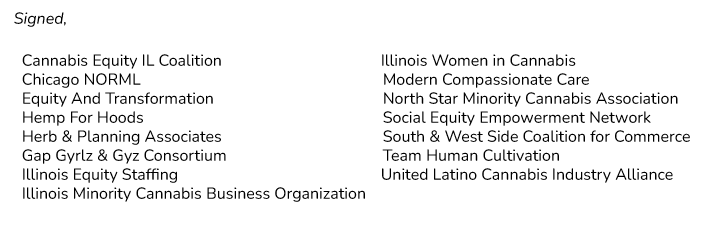
I was extremely pleased to see consumer-focused proposals relating to home cultivation in this one pager. In the one page document, the Cannabis Alliance requested support for the following priorities in 2024:
- Increasing Medical Patient Protections
- The coalition suggests allowing telemedicine for physical examinations and revising the ‘odor-proof container’ requirement to mitigate the risk of criminalization. Additionally, there’s a push to increase the limit on patient-grown plants, currently capped at five.
In a move that seems to recognize the diverse needs of medical cannabis patients, the coalition’s proposal includes language that would increase the plant count limit. This change could be particularly significant for patients who require a continuous supply of cannabis for their treatment, including those who prefer to create their own edibles or infused products. The process of making these products often requires a substantial amount of raw cannabis, making the current limit of five plants inadequate. By increasing the plant count, the proposal seemingly aims to ensure that patients have sufficient access to the cannabis they need for their treatment without the fear of criminal penalties. It is my hope that this shift reflects a deeper understanding of patient needs and a commitment to making medical cannabis more accessible.
Patients cultivating more than the allowed number of plants currently risk criminal charges. In other words, it appears that the primary objective of suggesting this as a legislative priority is to align the legal framework with the practical realities of medical cannabis use. This effort seemingly aims to ensure that patients are able to adequately and legally meet their medical needs, thereby reducing the risk of unnecessary legal complications.
It is important to note that according to reporting by Chicago Tribune, licensed operators have a history of opposing measures like home grow.
In addition to licensed growers, there is also the question of whether and how much people will be allowed to grow at home. A previous bill proposed five plants per home, which licensed growers and law enforcement oppose. But advocates say that’s the only way to guarantee that people can afford the drug if it becomes legal.
Robert McCoppin, Chicago Tribune. Source.
If you’re looking to learn more about the odor-proof container issue that is described in the one-pager, this topic has been discussed at length on The Cole Memo podcast and the Chillinois Podcast. Edited on 12/29/2024 to include: You can read my coverage of the rulings, including the first ruling here and the second ruling here.
Permitting telemedicine consultations would extend a trend initiated during the COVID-19 pandemic, which has since evolved into a widely accessible option for patients across the board.
The coalition’s proposals also include language that could address other issues that face cannabis consumers in Illinois.
- Tax Relief for Medical Cannabis Patients at Social Equity Dispensaries
- Rather than restricting patients to the original 55 designated medical dispensaries, the coalition suggests enabling these patients to utilize their medical cards at all dispensaries.
The coalition’s proposal, which advocates for allowing medical cannabis patients to visit any adult-use dispensary, is presented as a means to not only potentially enhance patient convenience but also to support the emerging social equity initiatives within the industry.
- Social Consumption Spaces
- The coalition suggests creating a licensing structure for cannabis lounges and temporary events.
The coalition has put forth a proposal concerning social consumption spaces within the cannabis industry. Their suggestion involves expanding the licensing for cannabis lounges and temporary events. This proposal includes granting municipalities the discretion to either license or disallow such consumption businesses. While the coalition presents this as a means to provide more legal consumption options beyond private homes, it does seem that the implications and effectiveness of such an expansion remain a topic for broader discussion.
In discussions with those involved in the consumption business sector, it seems that the current regulatory framework is generally seen as meeting their needs sufficiently, though not without some room for improvement. Concerns have been raised about the limitations on serving food on-site. Notably, venues like Molly’s Joint in Tilton, IL, and Okay Cannabis in Wheeling, IL, have devised practical solutions to overcome this hurdle. To add, some businesses(Three Mile Hideaway and Luna Lounge) have adopted a model where patrons are allowed to bring their own food, a strategy that simultaneously benefits other local businesses. A widely shared view among industry stakeholders across Illinois emphasizes the need for simplicity in licensing processes. To quote the faces behind High Minded Events “the way I see it is that we’re working the way we are…sometimes…less regulation is better”. In short, if it’s not broke, maybe we shouldn’t try to fix it. Illinois doesn’t have a great track record when it comes to making an accessible cannabis industry.
As it stands now, starting a consumption business in the state is seen as one of the more straightforward paths in the cannabis industry. This is largely because it primarily involves navigating local bureaucracy, which is often less stringent than dealing with state-level regulatory hurdles. Additionally, the process of acquiring tobacco retail permits, which are relatively inexpensive, contributes to making this one of the easier business types to get off the ground. The primary obstacle with starting a consumption business seems to be achieving profitability.
- SB0125 – Cannabis In Vehicle
- Law Enforcement is still allowed to use the odor of raw cannabis as probable cause to stop & search drivers. The coalition is suggesting that “odor proof” should be removed from Illinois vehicle code.
SB0125 was proposed in a previous session. You can see me discuss this issue with the attorney that drafted the legal language for SB0125 here and here.
- Employee Badging
- The coalition suggests reform of employee badging processes, advocating for a system that does not exclude qualified individuals solely based on past criminal convictions. The coalition calls for a standardized, streamlined online application process, aiming to remove unnecessary barriers to employment in the cannabis sector.
The badging process in the cannabis industry is fraught with bureaucratic complexities. A clear example of this, as conveyed by employees I have spoken with, is the protracted duration of the badging process. This lengthy procedure often leaves employees feeling trapped in their current dispensary roles, hesitant to transition to other opportunities due to concerns about the time-consuming badging process. For many, the prospect of a prolonged period without a paycheck is simply not viable. There are many other ways in which this issue can manifest itself.
- Items for further consideration
- The alliance proposed two items for further consideration:
- Regulatory consolidation
- Delta-8 regulation
- The alliance proposed two items for further consideration:
The proposal to streamline the regulatory framework for cannabis in Illinois has been a topic of discussion in multiple legislative sessions. Central to this idea is the belief that a singular, dedicated cannabis agency could more effectively serve the industry. Proponents of this consolidation argue that it would lead to a more cohesive oversight authority, enhancing both accountability and transparency within Illinois’ cannabis program. Historically, there has been debate over the optimal regulatory structure for the state. Key figures, including Vaughn Bentley, the Cannabis Regulation Oversight Officer, and licensees who have won social equity licenses, are among those who have voiced support for the establishment of a single agency. In contrast, the Cannabis Business Association of Illinois (CBAI) has previously expressed reservations about this model. Instead, CBAI has proposed the formation of a singular commission for overseeing cannabis regulation. It is also worth noting that a former Cannabis Regulation Oversight Office, under the lead of Danielle Perry, had endorsed the concept of a cannabis commission, as reported by GrownIn and confirmed by Vaughn Bentley in the Chillinois Podcast. So, it seems that everybody agrees that consolidation needs to occur, but it seems the disagreement comes with how the consolidation occurs.
The topic of hemp regulation, specifically concerning Delta-8 products, is not new to the Illinois legislative landscape. As reported by IllinoisNewsJoint, previous legislative efforts have encountered obstacles due to differing views on this issue. A notable point of contention, as highlighted by IllinoisNewsJoint, was the proposed ban on Delta-8 products. This ban, which reportedly gained support from major industry players such as Verano, Cresco Labs, NGW, and Pharmacann, significantly contributed to the discord between the Illinois House and Senate regarding the omnibus bill. The recurring nature of this topic underscores the complexity and varying interests at play in the state’s approach to hemp regulation.
The public debate around hemp-derived cannabinoids, particularly Delta-8 products, initially focused on safety concerns. This discourse shifted significantly when hemp operators proposed legislation requiring hemp businesses to comply with the same standards for taxation, testing, labeling, and identification as other licensed cannabis operations in Illinois. As a result, cannabis operators redirected the debate towards the issue of limited versus open licensing, pivoting the focus to concerns about “dilution of the market”. Reflecting this evolution in the public conversation, the debate I hosted on hemp-derived cannabinoids also underwent a similar transformation. This debate, accessible for viewing, serves as a microcosm of the changing attitudes and concerns in the broader context of cannabis regulation.
These priorities, if enacted, could significantly reshape the landscape of cannabis in Illinois, paving the way for a more inclusive and accessible industry. You can download and read the entire one pager, as I received it, below.
 The Cole Memo
Leave a comment